Showing posts with label Bahrain. Show all posts

Wednesday, April 4, 2012

Hezbollah, Israel, Iran and the LIon - Regional Update - April 4th

Firstly, We at the Middle East Analysis would like to apologise for our long delay in posting information. This update will obviously slightly longer than usual to explain the complete scenario.

Summary of Regional Situation:

- GCC conveys message to Russia that either way the revolution will win either via a coup or a war of attrition
- Syrian intelligence has  increased support to the PKK, in response to Turkish logistical support of the Free Syrian Army (FSA)
- Israel is on red alert based on intelligence inputs of Hezbollah preparing to launch a diversionary strike against Israel to get the Syrian people to divert their attention to Israel and also to any possible retaliation for an attack on Iran
- GCC on red alert in expectation of an Israeli strike which they believe can take place from any time now.
- Turkish government preparing for intervention in Syria - its a case of when, not if.
- Libyan veterans bought in by Qatar to join the ranks of the FSA

------------------------------


Contrary to news reports weapons have been reaching FSA and will do so in a faster way given that the US has decided to supply communication sets (that was previously being intercepted by Syrian intelligence).

Jordan and GCC intelligence mixed with western intelligence are running their intel/logistical/financial support from Iraqi sunni tribal areas.

PRC even though vetoed the UN resolution, they dont think Assad can survive. Damascus was the first major middle East Hub for the Chinese intel. The Syrian office of PRC state security Guanbu sent many messges to Beijing warning that Assad's fall is inevitable.


Apparently Guanbu has been on the ball on events in Libya and Egypt i.e. got it right. So the Top Brass at PRC  party HQ is listening.


Guanbu has a thinktank called the Chinese Institute of Contemporary International Relations- they have been tasked with preparing for the post assad world. The think tank told leadership to be neutral on Syria as whoever comes in next will guarantee all the contracts with PRC. PRC role mainly civilian but russian contracts maybe cancelled as mainly military in nature.


So, the GCC have signaled that the revolution will continue until the Syrians win, Russia has escalated with naval exercises etc, but the hope is that Russia will reach an accommodation with the GCC to guarantee each others interests. It is clear that there will be only one winner in this battle.


Reports coming from Syria suggest that Libyan mercenaries are being bought in by Qatar. Libyan embassy has been posting adverts for hotel rooms in several turkish cities. Officially these are war veterans who are coming to Turkey for medical treatment and will likely join the FSA camps or join the front line. Rumour has it Qatar is prepared to pay $1000 per month. This was given further credence as Gulf nations pledged $100million in salaries for FSA soldiers.

What is taking place in Syria is a clear proxy war.

Massoud Barzani from the Iraqi Kurdish Regional Government has promised Syrian Kurds that they will receive intelligence support for their cause.

The ultimate plan for the region under the GCC eyes is for Syria to become an independent Sunni power which protects the minorities. Then the next plan of attack is to ensure Hezbollah disarms in accordance to the UN security resolution. This resolution was agreed by Hezbollah originally. Hezbollah will become purely a political entity as a result.

Israel is likely/or will be encouraged to give up the Golan to the new "Free" Syria to push peace in the region.


Meanwhile, the next step will be to bring back Iraq from Iranian control and become an independent power. There is a renewed thrust to bring down Maliki of late hence why Maliki has begun to help Assad ever so slightly but remain neutral. Maliki knows he is next.

This is all to remove Iranian influence completely from the region. It is an open secret that the Gulf is in open conflict with Iran and they are determined to win!

Turkish General inspects troops on the Syrian border last week
 
Turkey in the next few weeks will be compelled to act by creating a humanitarian corridor as it sees the mounting number of refugees headed for Turkish refugee camps. Now that Damascus is giving money to the PKK to cause problems, Turkey will also have to act to prevent any miscreants from entering.

We predict that Erdogan would have conveyed to the Iranian leadership last week that the Turkish government is compelled to act in Syria and does not wish for conflict against Iran. So  All we can say Turkey is probably ready for intervention now and are ready to roll. It is communicating with Iran to prevent any escalation between them.

-----------------------------------

Israel continue to remain on red alert due to Hezbollah getting ready for a major offensive. Hezbollah hopes to deploy booby trapped drones and anti aircraft batteries. Also in expectation of a renewed confrontation with Iran, Hezbollah have been busy preparing. In order to mitigate their weakness on land and air, Hezbollah are currently busy doubling their underground tunnels and cave networks.


US and Israel continue to exercise regularly - a few months ago US troops had joined Israeli troops on the ground to deter any Hezbollah strike.

We could expect a pre-emptive attack any time by Israel against Hezbollah. The aim of the Hezbollah's action against Israel is not only for diversion but also to expend any Israeli hardware destined for Iran.

The GCC is also on red alert in expectation of an Israeli strike on Iranian nuclear sites at any time from now. A lot is being done to prevent this war - particularly the latest US intelligence assessment. This has not deterred the Israeli resolve. Although, US is keen to impress on the Israeli government that they should wait for the sanctions to bite. It usually takes 6 months for this to take place - hence by June/July we can start to see the effects. No one knows what the Israeli's are planning but the regional situation is such that Israel can attack Iran at any point.

Israel has also leaked the news that Israeli recovery crews will be based in Azerbaijan to rescue any downed pilots in a mission in Iran. Some Azeri politicians have also begun to call Northern Iran as Southern Azerbaijan!

We can also possibly expect Hassan Nasrallah to retire as the leader of Hezbollah after the Syrian war and be replaced by his deputy. But this is a story for another day.

--------

Thanks for your interest - as always drop your comments at "eye.on.middleeast" "At" Gmail dot com


Friday, July 8, 2011

Regional Update

Egypt


Egyptian Foreign minister Nabil Al Arabi appears to have been sacked due to favouring closer relations with Iran. It is likely that GCC may have put Egypt under pressure to withdraw this policy. We are aware that Murad Muwaifi (The head of the Egyptian General Intelligence Directorate) had met with his KSA counterpart and explained to him Egypt's decision to build up relations with Iran. Since this meeting, Egypt appears to have withdrawn from a brief flirt with Tehran. UAE and KSA continue to provide aid to Egypt.

The current Foreign Minister of Egypt made this statement in Bahrain: "The GCC security is an integral part of the collective Arab security and a strategic depth to Egypt’s national security".

Syria  


The Syrian regime appears to have sustained serious damage in the recent protests. Protests are still continuing in the Hama region. There appears to be a lot of defections from the lower rank sunni dominated parts of the military. The 76th Battallion appears to have suffered the most with over 100 defections (So bad that Maher Assad controlled troop had to move in to back up the 76th battalion). The air force appears to be pre-dominantly a sunni force and the Assad regime has sent out strong warnings to sunni commanders that defections should not be tolerated.

We continue to believe that with further sanctions targetting Assad supporters, key Syrian businessmen and with vast open/unpoliced/unfenced borders, it is likely that the regime will collapse. Therefore expect the worst in Syria.

Also reports from Lebanon suggest that black market prices for weapons have increased significantly due to Syrian demand. This also suggests that some countries are financing rebels in Syria.

Turkey has decided to use diplomacy and refrained from a military response yet.

We have learned that the Turkish intelligence agencies have sent warnings to Syrian and Iranian counterparts, not to harm Syrian refugees and expatriate Syrians in Turkey. This has raised the tension with Iran recently.

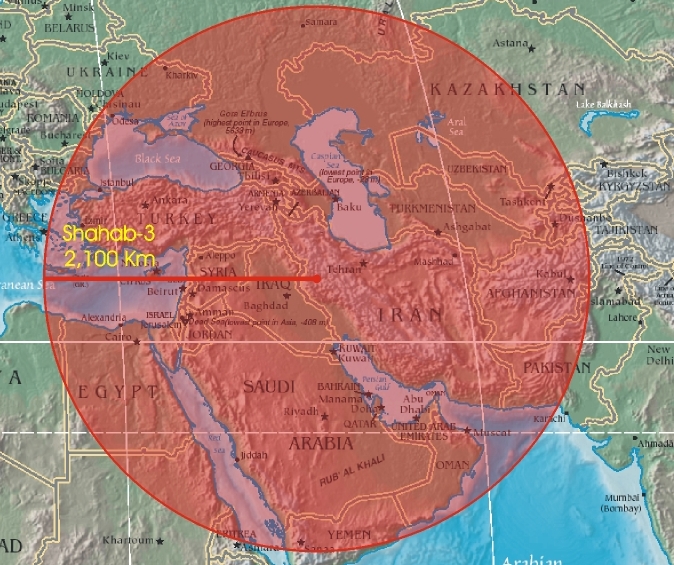
Shahab 3 Range

It is likely that the threat of joint US and Turkish intervention in Syria, led to Iran announcing the Great Prophet 6 military exercise. This exercise took place in the Northern borders close to Turkey and showcased the nuclear capable Shahab 3 missile (capable of striking targets in Europe). 

Iraq/Iran


Iran is developing the Mahdi army and Badr Brigade (part of the supreme Islamic Council) into a professional militia/force, that is an alternate to Hezbollah (or as powerful as Hezbollah).


The IRGC told them the plan is to reorganise the militia and arm them. So intructors will be giving them training in weapons handling and Missile launching. So the aim is to develop a force that can intervene in Syria, Lebanon - in support of Hezbollah and augment hezbollah operations in setting up covert cells in Kuwait, Bahrain, KSA. So if Hezbollah can't, the Mahdi army will take over setting up cells in GCC.

Tensions are rising again as Iran wants to make sure that the US does not retain any presence in Afghanistan and in Iraq. In order to achieve this, Iran has partnered with Pakistan and Iraq. Therefore, Iran has delivered more weapons to be used against the US troops in both Afghanistan and Iraq. Sadr has issued more threats and has even permitted suicide attacks against the US troops.

The US has wanted to change its role from a force that is currently policing the streets into a pure counter terror role and support Iraqi forces or Afghan National Army operations against insurgents. We can expect this to occur over the next few months.

"The current discussions cover both, and there are very clear capability gaps that the Iraqi security forces are going to have," Mullen said, citing air defense, aviation and elements of intelligence.


Iran


We understand that western intelligence agencies have concluded that Iran has now produced its first nuclear bomb prototype that is ready to be tested. Iran took advantage of the chaos during the "Arab Spring" to accelerate its program. Recently announcing that Iran will send a monkey into space. Any military analyst will point out that being able to put a payload into space will demonstrate ICBM capability. Rumours are circulating that a blame game has begun within western intelligence agencies.

It is likely that KSA and Turkey will come out with a plan to test nuclear weapons. Prince Turki has been the most vocal in this. Pakistan meanwhile has been expanding its nuclear weapons stockpile significantly and is likely to transfer the weapons technology. We have already reported in a previous article on GCC - Pakistan relations, of Saudi nuclear scientists receiving training in Pakistan. The GCC nuclear program is likely to be based in Khamis Mushayt and we believe that the program has been running for some years.

------------------
Pyongyang has relaunched North Korea’s enriched uranium production, a move that has coincided with Iran’s stocks growing.

In recent months, several European security services including the DGSE and MI6 have been swapping notes about intelligence from U.S. sources that Tehran has been receiving deliveries of UF6, uranium hexafluoride, used in centrifugation enrichment processes. This news comes at a time when Pyongyang is known to have relaunched its production of nuclear fuel.

The existence of a secret supply source from North Korea, if it turns out to be true, would strengthen the case for tougher sanctions against Iran. A report into secret technological exchange between the two countries, written by the United Nations’ panel of experts that monitors compliance with UN sanctions imposed on Pyongyang, was submitted to the Security Council in May. The report, which has not yet been published on China’s request, covers bilateral cooperation on ballistic missiles. On June 10th, the U.N renewed the panel of experts’ mandate.

----------------------

KSA


KSA and the US have partnered together on anti-AQAP operations. Leon Panetta and Gen. Petraeus have both told lawmakers that GCC will put "maximum" pressure on the AQAP. Prince Turki Al-Faisal and Prince Bandar bin Sultan were said to have lobbied the senior KSA leaders to allow a construction of an airbase for CIA/JSOC to operate drones from KSA. It appears that this base may not be operational yet and it is likely that some missions that began in May are operating from a neighbouring country as well as KSA.

The reason behind KSA okay'ing the plan was to prevent AQAP being given a free hand to operate in Yemen as this could affect the survival of the Kingdom. 

---------------------------------

Thank you for reading! Feel free to email us your comments at "eye.on.middleeast" at gmail dot com

Friday, June 10, 2011

The Saudi Perspective - DECODED!

A Saudi perspective on the Arab uprisings

Editor's Note: Nawaf Obaid is a Senior Fellow at the King Faisal Center for Research & Islamic Studies based in Riyadh, Saudi Arabia. He recently wrote an op-ed for The Washington Post entitled, Why Saudi Arabia is stable amid the Mideast unrest. Previously, Obaid was also private security and energy advisor Nawaf Obaid to Prince Turki al-Faisal when al-Faisal was the Saudi Ambassador to the United States.
By Nawaf Obaid – Special to CNN

The Arab world faces a period of historic upheaval: The economic and social malaise that existed in Tunisia before the revolution remains, and there is no realistic plan to turn the situation around.
Egypt's economy is in free-fall and the Muslim Brotherhood is poised to significantly increase its power through upcoming elections.
Civil war in Libya and escalating violence in Yemen have cost thousands of lives and set back development by decades.
Syria is on the edge of an abyss of nightmarish internecine warfare, which could spill into Lebanon, Turkey and Iraq.
The so-called "Arab Spring" has not brought new life to the Middle East, but leaderless anarchy, creating a virtual pan-regional movement that is alarmingly dangerous and ultimately unsustainable.
Recognizing the threat that the spread of this movement represents, Saudi Arabia is expanding its role internationally and mobilizing its vast resources to help countries facing domestic upheaval.
As the birthplace of Islam and the leader of the Muslim and Arab worlds, Saudi Arabia has a unique responsibility to aid states in the region, assisting them in their gradual evolution toward more sustainable political systems and preventing them from collapsing and spreading further disorder.
That the Kingdom has the ability to implement this foreign policy goal should not be in doubt - it is backed by significant military and economic strength.
The foundation for this more robust strategic posture is Saudi Arabia's investment of around $150 billion in its military. This includes a potential expansion of the National Guard and Armed Forces by at least 120,000 troops, and a further 60,000 troops for the security services at the Interior Ministry, notably in the special and various police forces. A portion of these will join units that could be deployed beyond the Kingdom's borders.
In addition, approximately 1,000 new state-of-the-art combat tanks may be added to the Army, and the Air Force will see its capabilities significantly improve with the doubling of its high quality combat airplanes to about 500 advanced aircraft.
A massive new missile defense system is in the works. Finally, the two main fleets of the Navy will undergo extensive expansion and a complete refurbishment of existing assets.
As part of this new defense doctrine, the leadership has decided to meet the country's growing needs for new equipment by diversifying among American, European and Asian military suppliers.
Few countries are able to support such considerable military investment, but Saudi Arabia occupies a unique position in that it has sufficient reserves and revenues to carry out the above plans, while also funding vital domestic social programs.
With 25 percent of the world's oil reserves and over 70 percent of global spare capacity, current projections for the next five years estimate that the Kingdom will earn on average about $250 billion in oil revenue per year (for 2011, the projection is almost $300 billion). In addition, the Kingdom has approximately $550 billion in foreign reserves, a sum it plans to steadily increase.
To maintain current oil export levels while at the same time fulfilling its growing domestic energy needs, the government is investing heavily in solar technology, and will spend more than $100 billion to build at least 16 nuclear power plants across the Kingdom.
Solar energy will fill the gap in the short term, satisfying some incremental domestic energy needs, and within a decade, plans call for nuclear power to play the leading role in augmenting oil as a source of domestic energy.
Thus, Saudi Arabia will be able to fuel the growth of its burgeoning economy without significantly reducing its oil exporting capability.
The Kingdom's more assertive policies are already apparent. It has provided Egypt $4 billion and Jordan $400 million (the latter could form the first installment of a much larger aid package that is being discussed).
Saudi Arabia is also leading the effort to improve regional collaboration by working to include Jordan and Morocco in a Saudi-centric Gulf Cooperation Council alliance.
In Yemen, it is spearheading diplomatic negotiations to effect a peaceful transition of power.
The Kingdom is the main supporter of Bahrain's monarchy, and will maintain a military presence there.
As Saudi Arabia grows more influential, initiatives such as these - which currently stretch from Morocco to Malaysia - will increase in number and reach, regardless of whether they meet with Western approval.
In Saudi Arabia, protests on the so-called "Day of Rage" predicted by pundits never materialized; the country remains stable and the leadership enjoys widespread support.
Those who are similarly skeptical about the Kingdom's ability to rise to its historic role as the indispensable regional power will again be proven wrong. The Saudi government will use its vast resources to steer the Arab world away from anarchy and unrealistic populist movements, and towards steady evolution in a manner that respects each country's unique culture and history.
The views expressed in this piece are solely those of Nawaf Obaid.
Despite the disclaimer at the end, we know that Nawaf Obaid has regular interactions with the highest levels of the Saudi government. Born of a Lebanese mother and Saudi father, Obaid has lived in Switzerland, where his mother resides, and studied in the United States. He holds degrees from Georgetown University, MIT and Harvard. His articles tend to be fairly accurate in terms of the positions taken by the Saudi government and are often prescient.

Nawaf's article DECODED:

  • They will back political political parties that are pro - Saudi in the Arab spring countries and if these parties come to power, the KSA government will back them to preserve a status quo. The KSA will do everything possible to preserve the status quo across the region and beyond (hence incorporating Jordan & Morocco) hence even supporting sunni monarchies such as Malaysia.
  • Interesting that he hints that the Saudi units "could" be deployed abroad. He is referring to the Saudi Special Forces and specifically we believe he is hinting at deployment in either Lebanon (to cut off Hezbollah) or possibly in Iraq to defend the sunni tribes. Cheney had proposed deploying sunni troops in sunni provinces of Iraq such as Al Anbar back in 2006.


  • Mentioning the specific Saudi plans to expand tanks, air force and army is a further confirmation that Saudi's will protect their own interests with minimal help of the US Security agreement. The emergence of a muslim brotherhood dominated Egyptian government is likely to be seen as a threat by the KSA government and particularly an egypt that is renewing diplomatic links with Iran. Therefore, the new air force/Naval purchases and expansion will be so that KSA can deal with a 2/3 front war (Red sea, arabian gulf, Iraqi borders).
  • Tier 1 and 2 (high tech equipment such as Aircraft or Electronic warfare equipment) purchases will be from US/EU defence firms with some Russian systems, but Tier 3 equipment will be purchased from possibly China or India or maybe Russia.
  • Saudi aid to Jordan is an incentive for Jordan to join the GCC. Once Jordan joins the GCC, it will be able to take advantage of larger aid packages.
  • The article hints that KSA is likely to build a permanent base in Bahrain.
  • The last paragraph reaffirms that KSA will do everything to prevent further pro-democracy movements in the region.


    We'd also add that KSA will have to train up a vast number of Saudi defence personell, as it currently relies mainly on deputed Egyptian and Pakistani officers to man aircraft/naval vessels. The large increase in defence assets would also mean that more such officers will be brought in termporarily from Pakistan, Egypt, Jordan and other countries until Saudi officers are able to take over. This further re-affirms the position of Pakistan as a strategic partner to KSA.

    Meanwhile, the Iranian government hasn't sat back to these latest developments. Stay tuned for the next post which will detail the Iranian response!

    Feel free to post a comment or email us your views at eye.on.middleeast "At" Gmail "dot" com.

    Saturday, May 21, 2011

    Regional Update

    Hi Folks!

    The Editor has been busy monitoring the news, holidaying in various locations in the med.

    ---------------------------
    First Stop: KSA and the US relations.

    This is a must read article on the US - Saudi split in relations.

    Amid the Arab Spring, a U.S.-Saudi split

    By Nawaf Obaid, Published: May 16

    RIYADH, SAUDI ARABIA
    A tectonic shift has occurred in the U.S.-Saudi relationship. Despite significant pressure from the Obama administration to remain on the sidelines, Saudi leaders sent troops into Manama in March to defend Bahrain’s monarchy and quell the unrest that has shaken that country since February. For more than 60 years, Saudi Arabia has been bound by an unwritten bargain: oil for security. Riyadh has often protested but ultimately acquiesced to what it saw as misguided U.S. policies. But American missteps in the region since Sept. 11, an ill-conceived response to the Arab protest movements and an unconscionable refusal to hold Israel accountable for its illegal settlement building have brought this arrangement to an end. As the Saudis recalibrate the partnership, Riyadh intends to pursue a much more assertive foreign policy, at times conflicting with American interests.
    The backdrop for this change are the rise of Iranian meddling in the region and the counterproductive policies that the United States has pursued here since Sept. 11. The most significant blunder may have been the invasion of Iraq, which resulted in enormous loss of life and provided Iran an opening to expand its sphere of influence. For years, Iran’s leadership has aimed to foment discord while furthering its geopolitical ambitions. Tehran has long funded Hamas and Hezbollah; recently, its scope of attempted interference has broadened to include the affairs of Arab states from Yemen to Morocco. This month the chief of staff of Iran’s armed forces, Gen. Hasan Firouzabadi, harshly criticized Riyadh over its intervention in Bahrain, claiming this act would spark massive domestic uprisings.
    Such remarks are based more on wishful thinking than fact, but Iran’s efforts to destabilize its neighbors are tireless. As Riyadh fights a cold war with Tehran, Washington has shown itself in recent months to be an unwilling and unreliable partner against this threat. The emerging political reality is a Saudi-led Arab world facing off against the aggression of Iran and its non-state proxies.
    Saudi Arabia will not allow the political unrest in the region to destabilize the Arab monarchies — the Gulf states, Jordan and Morocco. In Yemen, the Saudis are insisting on an orderly transition of power and a dignified exit for President Ali Abdullah Saleh (a courtesy that was not extended to Hosni Mubarak, despite the former Egyptian president’s many years as a strong U.S. ally). To facilitate this handover, Riyadh is leading a diplomatic effort under the auspices of the six-country Gulf Cooperation Council. In Iraq, the Saudi government will continue to pursue a hard-line stance against the Maliki government, which it regards as little more than an Iranian puppet. In Lebanon, Saudi Arabia will act to check the growth of Hezbollah and to ensure that this Iranian proxy does not dominate the country’s political life. Regarding the widespread upheaval in Syria, the Saudis will work to ensure that any potential transition to a post-Assad era is as peaceful and as free of Iranian meddling as possible.
    Regarding Israel, Riyadh is adamant that a just settlement, based on King Abdullah’s proposed peace plan, be implemented. This includes a Palestinian state with its capital in East Jerusalem. The United States has lost all credibility on this issue; after casting the sole vote in the U.N. Security Council against censuring Israel for its illegal settlement building, it can no longer act as an objective mediator. This act was a watershed in U.S.-Saudi relations, guaranteeing that Saudi leaders will not push for further compromise from the Palestinians, despite American pressure.
    Saudi Arabia remains strong and stable, lending muscle to its invigorated foreign policy. Spiritually, the kingdom plays a unique role for the world’s 1.2 billion Muslims — more than 1 billion of whom are Sunni — as the birthplace of Islam and home of the two holiest cities. Politically, its leaders enjoy broad domestic support, and a growing nationalism has knitted the historically tribal country more closely together. This is largely why widespread protests, much anticipated by Western media in March, never materialized. As the world’s sole energy superpower and the de facto central banker of the global energy markets, Riyadh is the economic powerhouse of the Middle East, representing 25 percent of the combined gross domestic product of the Arab world. The kingdom has amassed more than $550 billion in foreign reserves and is spending more than $150 billion to improve infrastructure, public education, social services and health care.
    To counter the threats posed by Iran and transnational terrorist networks, the Saudi leadership is authorizing more than $100 billion of additional military spending to modernize ground forces, upgrade naval capabilities and more. The kingdom is doubling its number of high-quality combat aircraft and adding 60,000 security personnel to the Interior Ministry forces. Plans are underway to create a “Special Forces Command,” based on the U.S. model, to unify the kingdom’s various special forces if needed for rapid deployment abroad.
    Saudi Arabia has the will and the means to meet its expanded global responsibilities. In some issues, such as counterterrorism and efforts to fight money laundering, the Saudis will continue to be a strong U.S. partner. In areas in which Saudi national security or strategic interests are at stake, the kingdom will pursue its own agenda. With Iran working tirelessly to dominate the region, the Muslim Brotherhood rising in Egypt and unrest on nearly every border, there is simply too much at stake for the kingdom to rely on a security policy written in Washington, which has backfired more often than not and spread instability. The special relationship may never be the same, but from this transformation a more stable and secure Middle East can be born.
    The writer is a senior fellow at the King Faisal Center for Research & Islamic Studies.

    I don't think I need to comment further as the article has spelt out clearly the current status of US-KSA  relations.

    ------------------------------------------------------------------------------

    Next Stop: GCC Integration with Jordan and Morocco.

    Readers have been emailing in asking why this has taken place? One word: Iran.

    With a possible clash with Iran over meddling in the GCC, KSA has decided to strengthen its alliances by adding Jordan and Morocco.


    The obvious meaning of this deal is that these countries will be automatically integrated with the GCC. GCC money will flow into both countries, thereby strengthening them economically. The lower cost labour will flow in and perhaps replace Asian labourers. This of course makes sense, as nations would rather have individuals who can easily integrate and have language and religious affinity (E.g. Poland integration into EU).

    The real reason in our opinion is, in the event of a faceoff with Iran, shia Iraq will be allied with Iran and MAY attack or work with Iran to fight Sunni GCC.

    During the Bahrain crisis, Muqtada Al Sadr had threatened to send shia tribesmen to the border with Kuwait and KSA to open a armed front in solidarity with so called peaceful protesters in Bahrain.  Therefore, to secure themselves Jordan and Morocco will be able to tie down Iraq and prevent Iraq from attacking Kuwait.

    Yes this does sound like the nuclear scenario, where borders may be redrawn on religious lines. But GCC can't afford to take chances if Iran continues its behaviour of meddling in internal affairs of other countries.

    This story further continues when we discuss Syria and Iran.

    ---------------------------------------------------
    Syria


    Syria is facing a lot of protests. The Muslim Brotherhood (MB) appears to be playing a small clandestine role against Bashar Al Assad. The KSA GID (General Intelligence Directorate) has established contacts with the MB via tribal networks. Saudi's are prepared to deal with sunni islamist MB to prevent any expansion to Iranian influence in the region and therefore corner Hezbollah in Lebanon.

    There are rumours afloat that KSA is funding and arming various groups via Jordan to defeat the Assad regime . This rumour also suggests that Prince Bandar bin Sultan (Former KSA Ambasador to the US) is running this operation from Jordan. The rumour was given further credence as Syria had closed of the Jordanian border and lately Syia has accussed Saudi of supporting Syrian terror cells.

    Jordan is a major front for most US intelligence operations and have worked together with the Saudi's  in Lebanon. So the accusation coming from Assad's government does make sense to this editor.

    80% of the population in Syria is sunni. So a sunni Syria may also be a potent deterent against any potential moves of Iran and Iraq against Sunni GCC.

    -----------------------------------------
    Iran: Ahmadinejad - Khamanei spat


    To justify Ahmadinejad's decision to sack the minister for intelligence Haidar Moslehi, in a meeting with Iranian supreme leader, Ahmadinejad complained of recent failures to take advantage of protests in Bahrain and Saudi Arabia.

    In Kuwait, various iranian spy networks have been dismantled and diplomats expelled. The Ministry of Intelligence and Security was reduced to organising protests outside the KSA embassy in Tehran and consulate in Mashaad.

    These were the main reasons why Ahmadinejad and Khamanei had a fall out. Khamanei wanted to keep Moslehi due to upcoming elections and various other reasons.

    This further confirms that Iran did attempt to capitalise on protests in Bahrain and KSA.

    ------------------------------------------

    Thats all for now folks. Feel free to post a comment or email us your views at eye.on.middleeast "At" Gmail "dot" com.

    Thursday, March 24, 2011

    Quick Update: Libya, Syria + GCC


    Hi Folks!

    Here is a short update on Libya as well as the GCC.


    British Royal Air Force (RAF) Typhoon aircraft taxi at Gioia Dell Colle Air Base, in Italy March 22, 2011

    Libya

    • We expect to see more coalition strikes on Gaddafi's armed forces. In particular we expect Libyan tanks and other artillery equipment to be destroyed over the next few days.
    • If a settlement is to be agreed, we expect the country to be split into 2 - Tripolitania and Cyrenica. Where Gaddafi will retain control of the West (Tripolitania) with the rebels holding the East (Cyrenica).
    • The person running the rebellion is Gaddafi's former interior minister Younis Al Obaidi, who is backed by a few military officers.
    • One of the officers backing Obaidi is supposedly close to the US pentagon. As the WSJ had reported the Libyan National Council can rely on arms supplies coming from over the border in Egypt that is indeed partly financed by the KSA.
    • Obaidi's aim is to recapture Adjdabia from the Gaddafi forces, since the western coalition air force is taking out any Gaddafi forces on the main highways. Once this is complete, we believe he will head for the coastal oil transportation hubs - especially Ras Lanouf ( a site of a major oil export terminal). 
    • Capture of these oil export terminals would mean oil revenues and hence greater viability of the state of Cyrenica. Establishing a state of Cyrenaica is the minimum the rebels aim to achieve at the moment.
    • A problem Obaidi is facing is that the force is filled with enthusiastic civilians who have very little military training. 
    • Meanwhile Gaddafi is aiming to grab Zintan and Misrata as well as other Western towns. These cities would be important to be able to stabilise the Tripolitania region.
    • We expect additional political appointments to be made over the coming week - we strongly expect Ali Issawi (the former Ambassador to India) to be given a very senior posting - either in Foreign Affairs or Economy.
    • We believe most western capitals are now debating on the end game in Libya - as in what the west hopes to achieve in Libya. Also at what point do they cease military operations.

    GCC

    Soldiers from the Gulf Cooperation Council (GCC) forces guard the entrance to the Pearl Square from their armoured vehicles in Manama, March 19, 2011.


    KUWAIT CITY — Arab states in the Gulf plan to deport thousands of Lebanese Shiites over their alleged links to Hezbollah and Iran's elite Revolutionary Guard force, a Kuwaiti newspaper reported on Thursday.
    Al-Seyassah, quoting London-based Arab diplomatic sources, said the measure was being considered because of intelligence reports that Lebanese Shiites activists had been involved in protests in Bahrain and Saudi Arabia.
    Based on the assessments by the United States, France and Bahrain, alleged Hezbollah and Revolutionary Guard agents were leading the protests along with local Shiite clerics in Bahrain and Saudi Arabia's Eastern Province, it said.
    It said Bahrain's decision to suspend flights to Iran, Iraq and Lebanon and its condemnation of remarks by Hezbollah chief Hassan Nasrallah had "paved the way for the deportation of thousands of Lebanese Shiites from the Gulf."
    "No Lebanese Shiite linked to or suspected of being associated with Hezbollah and the Revolutionary Guards will remain in the Gulf," the diplomatic sources said, citing high-ranking Bahraini officials.
    Bahrain is preparing to deport 90 Lebanese Shiites, most of them arrested during the Shiite-led, pro-democracy in the kingdom, and is examining the status of 4,000 Lebanese families living in the Gulf kingdom, the sources said.
    Last week, Bahraini authorities carried out a bloody crackdown on the protesters who have been demanding political reforms since February 14 in the tiny Shiite-majority, Sunni-ruled kingdom.
    The crackdown came hours after a Saudi-led joint Gulf force rolled into Bahrain to back up the regime, a move condemned by Shiite Iran and the head of Lebanon's Shiite militant Hezbollah who has offered to help the demonstrators.
    On top of the suspension of flights to Beirut by its two national carriers, Manama has advised Bahraini citizens to avoid travel to Lebanon, a popular destination for wealthy Gulf Arabs.
    "Due to threats and interference by terrorists," the Bahraini foreign ministry said on Tuesday it "warns and advises its citizens not to travel to the Republic of Lebanon as they might face dangers threatening their safety."

    Bahrain and KSA have pointed the finger at Iran for the unrests that have taken place over the last few weeks. This is evident by HM King Hamad's speeches of an external hand in the protests and also by the expulsion of diplomats between Iran and Bahrian.

    The expulsion of Lebanese nationals appears solely directed at Iran and Iranian interests. The MOIS (Iranian Ministry of Intelligence Servies) and IRGC (Iranian Revolutionary Guards Corps) are known to use Lebanese nationals for their operations in the GCC. This article suggests that several individuals appear to have been caught taking part in protests.

    The expulsions of Lebanese individuals linked to the Hezbollah will serve to heighten the tensions between Iran and also to protect the KSA and Bahrain from any potential Iranian involvement in any unrest or future protests.

     Due to the large Lebanese community in Bahrain, any expulsion may also serve as a sanctioning of the Hezbollah led Lebanese government. We see this similar to the sanctioning of the Hamas government in Gaza by the EU after winning the democratic led elections. However for this to be truly effective, it would require a GCC wide expulsion of Lebanese individuals - the article above does suggest that there may be a GCC wide expulsion and we agree that a GCC wide expulsion may take place. There have been reports in late 2010 of expulsion of Hezbollah supporters from the UAE, so this would not be the first time that a Gulf state has taken action against lebanese expatriates in the Gulf.

    Iran has making its own moves recently, by allowing Iraqi shi'ite political parties to form an alliance against the "KSA intervention" in Bahrain. This alliance has threatened to open a front (by sending shia tribes to the border) in the KSA/Iraq border in solidarity with the Bahraini shia.

    Syria

    In light of the major protests in Syria. This has caused serious worries of instability in neighbouring Iraq - across all parts of the country. Therefore, the Kurdistan Regional Government and the central government in Baghdad have struck an agreement to provide for security of all northern iraqi oil fields.

    It appears that there is a heightened risk of serious instability all over Iraq as a result of a protests in Syria. We expect tightening of the border security between Syria and Iraq over the next few days in order to prevent any instability spreading into Iraq.

    ----------------------

    Thank you for reading. Feel free to email us any questions you have to eye.on.middleeast "at" gmail "dot" com.

    Wednesday, March 2, 2011

    MENA Region - Quick Update

    Editor has not been sleeping and is watching the current events unfold.

    First Stop: Libya

    Many are wondering what is going on in Libya. We'll make this simple.
    The eastern side of Libya is currently held by "rebels". These rebels are essentially members of the armed forces of Libya and the people.


    Do we see them winning? Nope. We do not. As long as Gaddafi continues to control the Airspace,
    he may continue to bring in troops/Mercenaries from Niger, Chad, Syria etc. Yes that's right Syria is not a typo, Syria is showing solidarity with Libya and in the event of a full scale war, Syria will send their pilots to fly on behalf of the Libyan Air Force.

    We believe that the western intelligence agencies are busy on the ground in Libya, trying to organise the rebel movement and of course evacuate their nationals. So far the french and british have delivered "aid" and weapons to the rebels.

    Rebel soldiers teach civilians who have volunteered to join the rebel army at a school in Benghazi March 2, 2011. The rebel army is preparing to fight Libyan leader Muammar Gaddafi's forces if necessary, an official in the rebel army said.


    Talks of no-fly zone are just that - talk, at the moment. Its something that is too difficult to impose as it would involve a US/western intervention and bombing spree. The current economic/political climate in the EU and the US does not allow for this - which is evidenced by Secretary of Defence Gates comments in the last few days.

    No one appears to be covering the damage that the current crisis is going to cause the Spanish economy, which would feed into the EU economies. 

    So in summary: We do not see an intervention by the West at this juncture. Rebels are slowly losing territory to Gaddafi's military evidenced by re-gaining Al Bayda today. Unless, the west enforces a no fly zone via Egypt etc anti-government forces will get over run.

    We'd also like to point out that there is a heavy propaganda going on here by the west. Good quality information is particularly hard to receive at the moment.

    Shades of Saddam here. By no means is this over yet - this war may continue for a while.


    Next Stop: Bahrain

    The process of national dialogue has begun by Crown Prince Sheikh Salman, the PM and Sheikh Nasser bin Hamad (HM King Hamad's son playing a limited role).

    The opposition party Wefaq and Haq have met and are discussing their position on the issue. To date it appears they have agreed on certain issues and have had some disagreements. It is not clear what each's position is on asking for a constitutional monarchy.

    The author commends the Crown Prince's call for dialogue. It is clear that others have copied this process/idea -> President Saleh (Yemen), Saif Al Gaddafi (Libya) are doing similar things.

    The talk of the town was Bahraini King Sheikh Hamad visiting Riyadh to receive King Abdullah of KSA in Riyadh last week.


    Saudi Arabia's Crown Prince Sultan (R) smiles with Bahrain's King Hamad bin Isa as they welcome the arrival of Saudi Arabia's King Abdullah, in Riyadh February 23, 2011.
    King Abdullah got straight to business after landing. He had to deal with the Bahrain issue and also internal family issues that needed sorting out.

    Regarding Bahrain, King Abdullah affirmed support to Bahrain and to the royal family. He told King Hamad that he supports the dialogue process initiated by the Crown Prince. They both agreed that using violence by the police or military is not the answer as it will eventually help Iran. King Abdullah also said that there are 3,000 Saudi troops stationed in the east that are on alert and are ready to help support the BDF (Bahrain Defence Force). Saudi officers are present already in Bahrain to help with any coordination, in the event of a crisis.

    Oman

    Protests have taken place in an industrial city of Sohar and troops have been deployed. We are monitoring this situation closely.

    This is not an anti-monarchy protest. The people are in support of Sultan Qaboos, however they are not happy with the government ministers, whom they accuse of corruption. It is also about jobs for the unemployed and so on. We expect the protestors demands to be met to a certain extent and this will probably go away in a matter of days.

    India and GCC

    Prince Turki Al Faisal will be in New Delhi on the eve of the first Joint Indo-Saudi military exercises in India.

    Omani troops are also expected to come to India for a massive Air, Sea and Land exercise in India this month.

    Army Chief to visit US Centcom HQ


    The India-US military relationship is set for a qualitative leap with the first ever visit of an Indian Army Chief to the headquarters of the US Central Command (Centcom), which has charge of Af-Pak, the Middle East and Iraq.

    Gen. V K Singh will visit the Tampa, Florida-based Command in his 10-day trip to the US between March 6 and 15 with an aim to set up a Brigadier-level direct liaison with the Indian Army. India liaises only with the US Pacific Command, and having a liaison officer in Tampa will signal a recognition of Indian interests in the arc from the Gulf of Aden to the Straits of Malacca, government sources said.

    The Centcom liaison and acquisition of M777 ultralight howitzers will figure in the bilateral Defence Policy Group meeting, for which a high-level delegation led by Defence Secretary Pradeep Kumar is going to Washington on March 1. Sources said Gen. Singh will meet Centcom Commander Gen. James Mattis on March 8 to discuss the situation in Af-Pak, the Arab world and Iraq. Gen. Singh will also hold talks with his US counterpart Gen. George W Casey Jr.

    IndianExpress


    Watch this space!
    ----

    Thanks for reading. Feel free to email us any questions at eye.on.middleeast "at" gmail "dot" com

    Saturday, February 19, 2011

    Arab Unrest - Quick Update

     Egypt

    Anyone who read my previous post about Washington's message to the Egyptian leadership would have been surprised at how things did turn out.

    Our prediction is that the military may not hold elections in 6 months time, contrary to what the junta are saying in Public. The military prefers to maintain control of the economy as it remains heavily invested. Initial reports appear that arrests of the previous ministers who were pro-economic liberalization have taken place. There appears to be a socialist slant towards comments being made by the military leaders.

    The Egyptian military wants to protect its interests and therefore we believe that it is unlikely that the junta will go after Mubarak's money as this may show the level of involvement of the Egyptian military as well as several high profile individuals from around the world (including Israeli's).

    We also think that if there is democracy to be established, there would be 2 possible models:

    Turkish: Islamists and liberals allied with a strong military. This is what the people of Egypt desire.

    Moroccan/Pakistani:  Free parliament, elections, but ultimate control of security issues is directly with King/Kayani/Egyptian Army.

    The decision on direction may take a long time to play out (possibly greater than 6 months). Its clear to us that the military do not want to see a Turkish situation where the senior generals have been placed under arrest for attempts at coup. Therefore, the Egyptian military is interested in protecting its political power and obtain immunity from any arrests, but retain the power to intervene politically when it feels the need to do so (much like Pakistan).

    Bahrain


    Well many would have seen the protests that are currently taking place in Bahrain.

     I think that the Bahrain situation is being fanned by the western media. There is a lot of anti-government propaganda by  well respected journalists such as Nick Kristof from the NY Times. There are currently petitions being circulated against this journalist.

    We at Eye on the Middle East believe that the Bahrain monarchy WILL NOT FALL! This is based largely on comments made by the mainstream opposition (Al Wefaq and others) parties. There are some calls to remove the Al Khalifa dynasty but this is not widely echoed by protestors, in fact, most anti government protestors just want economic reform more than the political reform.

    The Crown Prince has appeared on CNN earlier today, which is a great idea to explain to the world at large the views of the government of Bahrain. See Link 


    Why were the BDF (Bahrain Defense Force) deployed?  From what we see, the BDF was deployed to protect national infrastructure such as oil infrastructure and parts of the city as a show of force. We have heard that the Saudi's had asked Bahrain if they require any extra forces, however HM King Hamad had decided not to use force against the protestors.

    The BDF were deployed because the Bahrain NSA had most likely received intelligence that Iranian backed movements had decided now is their time to launch their civil disobedience movement which would want to damage infrastructure.

    For many years, the Bahraini security services have watched individuals travel to Qom (Iran) for religious training and then onwards for training with IRGC & Ministry of Intelligence Service on basic intelligence gathering skills, Civil disobedience movements and arms training. We have learned via sources that the Iran backed elements were split into 2 groups, people that wanted to act now and others who preferred to use these tactics only in the event of a major conflict with Iran.

    Lets not confuse these Iran backed elements with normal protestors who were out there to ask for political and economic reforms. The vast majority of protestors want this, but sadly the trouble makers attempted to take advantage of the situation.


    Another major reason to deploy the BDF was to prevent any clashes breaking out between pro and anti government protestors. The seriousness of the incidents could have sparked a civil war in Bahrain. Thankfully, none of this happened.


    There have been more trade union strikes that have been called for Sunday 19th and Monday 20th February.

    It does appear many opposition parties have agreed to dialogue with HH Crown Prince Salman earlier today and the removal of the BDF from the streets of Manama was seen as a positive step. The Crown Prince has attempted to defuse the situation and hinted at an economic package being delivered to all Bahraini citizens. So, the editor believes that this situation will be resolved relatively soon.

    Libya

    Meanwhile, early reports suggest Libya will be the next domino to fall. Reports are streaming through mainstream media that the Eastern part of Libya (Bengazi in particular) is now completely under the control of the people! It does appear that many have lost their lives.

    Oman

    Sultan Qaboos has cancelled his month long visit to India due to the prevailing situation in the Middle East.

    It is important to note that Indian and Omani forces are due to conduct a major military exercise next month.

    Monday, January 3, 2011

    Iran and the Nuclear Issue

    Iran has been dominating the news over the last few years, mainly due to its development of a Nuclear Program.
    Lets assess the issue at large, interests of each country in the region and world at large.


    Iran's Nuclear Program 

    Iran's nuclear program appears to be the most pressing issue for the GCC and the west.

    What does Iran stand to gain by going nuclear?

    It is the same reason why India and others went nuclear. In the words of Former Indian President Abdul Kalam, nuclear weapons are a "weapon of peace". First and foremost for Iran, it is to deter aggressors/bullying and protect the country from the US. Having a nuclear weapon, can deter a major war and essentially cements Irans position as a regional and international player in politics.
    Secondly, I believe it allows Iran to flex its muscles regionally. Consequently this is the biggest worry for those in the GCC.

    The Iranians continue to agree to talk, just in order to stall for time and keep the clock ticking so that Iranian nuclear scientists can continue to work. It’s just a question of time for the Iranians to come out and say they have a bomb ready for testing.

    Will the Iranians actually use it?

    You may have heard in the press of Ahmadinejad telling people that Israel will be wiped off the map etc. The west is using this as a tool to scare ordinary people and obtain support for their governments actions on stopping the Iranian nuclear program.

    No nation is crazy enough to use it as it will likely be met with an equi-proportionate nuclear response, especially if the target nation has a triad of nuclear missiles (Missiles/Bombs deliverable via Land systems, Airplanes and using Submarines).

    Iran and perhaps the nuclear powers too, believe in MAD (Mutually Assured Destruction). This is where both sides have enough nuclear missiles to cause serious damage to each other.

    So its safe to say that Iran isn't actually getting a nuclear weapon in order to use it, its more of a deterrent and use as a support to foreign policy objectives. However, as the USSR showed us, possessing a nuclear weapon does not guarantee the regime power to rule for an infinite period. Regime change is still very much possible and will continue to be a major threat in my opinion.

    Factors to keep in mind:
    - It takes more than one test to perfect the weapon (The West have conducted 100's of tests to perfect theirs)
    - Even once you have a weapon, you need a credible delivery vehicle that can reach your intended enemy. This can take many years.

    Anyone interested in understanding why India went nuclear and how it outsmarted the US in going nuclear, please read Weapons of Peace: The Secret Story of India's quest to become a Nuclear Power by Raj Chengappa.

    The US

    The views of the senior leadership in Iran is that the US cannot afford another major war. The US has announced timelines to pull out of Iraq and any increase in violence in Iraq will probably slow this process. Iran can obviously make it difficult for the US to pull out. An attack on Iran will in all likeliness cause an upsurge in violence in Iraq by Al Qods forces (Iranian special forces troops controlled by the Iranian Revolutionary Guard Corps). and Iranian controlled militia - specifically the Mahdi army (Officially disbanded but highly active in the South of Iraq) who have been undergoing training with the Hezbollah/IRGC in Iran.


    Of course this is also a similar situation in Afghanistan, where certain part of the Taliban are backed by Iran. Evidence of Iranian made shells, weapons etc have showed up in Afghanistan[1]. Members of the Taliban still receive training in Iranian bases close to the border with Afghanistan.

    Now the biggest reason why the US can't afford another war is because of its economy. Recent data published by the US Department of Labor of high unemployment (9.8%[2]) Some people go as far as to say that the unofficial US unemployment rate taking into consideration those that have not claimed unemployment benefits is around 1 in 5 people. The economic situation is not improving very much either, this can be witnessed by recent remarks of Ben Bernanke and further stimulus plans.

    Imagine if the US was to go to war with Iran, would ordinary people in the street in the West be happy with this? Probably not. Public opinion would frown at such an idea, and will not be happy with a significant portion of their budgets/taxes being spent on "another war!”. Tehran also appears to agree with the idea that US cannot afford another war[3]. In my opinion this is also the same reason why Israel is being held back from attacking Iran, simply because Israel would not be doing itself any favours with the West (support that it needs for its very survival).

    The GCC


    The GCC is the one that is most worried about the Iranian threat. One can witness the statements from the recent wikileaks saga:  HM King Abdullah of Saudi Arabia repeatedly exhorted the United States to "cut off the head of the snake" by launching military strikes to destroy Iran's nuclear program.

    HM King Hamad of Bahrain argued "forcefully for taking action to terminate  Iran's nuclear program, by whatever means necessary". "That program must be stopped," he was quoted as saying. "The danger of letting it go on is greater than the danger of stopping".

    An Iranian nuclear weapon will provide a lot of power on foreign policy. Each nation in the GCC approaches the issue of Iran differently:

    KSA

    A crux of the issue for the Saudi's appears to be that Iran is a challenge for their regional power and a leader of Islam.

    There are also worries that Iran will be able to meddle in the internal affairs of the Kingdom, especially amongst the significant Shia population in the East of the Kingdom (the majority of saudi oil is located in this region). Worst comes to worst Iran could back a succession movement in the East of the Kingdom.

    Bahrain

     Similar to the Saudi's, there is a significant Shi'ite population in the island nation. Bahrain has a long history with Iranian meddling in Internal affairs of Bahrain. The majority of the population in Bahrain is Shi'ite and the rulers are Sunni. I'll go into Iranian activities in the GCC as a whole in another post.

    Qatar

    Main issue for Qatar is believe it or not NATURAL GAS! Both Iran and Qatar share the worlds largest natural gas fields. They are competitors, in this way and are trying to extract as much gas as possible. As the sea borders are not actually demarcated by either Iran or Qatar, this can be a source of conflict. Iran has displayed aggression here by routinely sending IRGC personnel in boats to damage Qatari Gas infrastructure[4].

    UAE


    Lesser Tunb, Greater Tunb and Abu Mussa Islands that are claimed by the UAE but currently under occupation of Iran.

    The GCC

    I have left out Kuwait, Oman and Qatar on purpose as most of the issues are covered above. Iran has made threats of attacking GCC nations in the event of any US/Israeli strike coming from their territory. Iranians have also made it clear that they have covert cells in the GCC, in the event of war, will be activated to damage infrastructure (electricity, roads, etc), conduct suicide attacks.

    Is this threat for real? Bahrain has faced these threats from the 80s and have dismantled many cells since. Even to this day, building construction work in Manama usually ends up finding buried cache's of professionally packed weapons[5].

    Trained in Iran or in Hezbollah camps in the Oronte valley in Lebanon, the elements aim to launch sabotage operations against American and European interests in the event of an attack against Iran. In the event of a war, Iran will use these sleeper cells to launch a civil disobedience movement and send people to the US embassy and to the HQ of the 5th fleet in Manama5.

    The Saudi decision to set up a force to protect oil facilities came because of the discovery of Iranian infiltrated operatives in the East of the Kingdom.

    So in short, Yes the Iranian threat is very real.

    Conclusion

    Will there be war?

    Mmm.... Not sure. At this point in time, the US can't afford a war and neither will the US let anyone else launch any attacks against Iran. But Israel and the West will probably continue to use other methods to slow Iran down - Stuxnet and other covert means.

    Does Iran want war?

    Despite all the loud noises from Iranian generals of how they will strike their enemies, the Iranians do not want war. Iranians know that they will come out worse in any major war with the US. Iranians are happy to make gutsy moves, like the recent visit to the Lebanon - Israel border by Ahmadinejad, use IRGC boats to intimidate US Navy ships in the Straits of Hormuz. But in my opinion Iran will not do anything major to provoke the US.
    In short, neither US or Iran wants a war! Neither will provoke the other in any big way.

    What will happen if Iran does nuclearise?

    The GCC will make peace with Iran and satisfy their needs. Game theory tells us that the GCC will probably nuclearise (How? Thats a different matter altogether). We have also seen this in the past between India and Pakistan. India was first to nuclearise and Pakistan responded with attaining nuclear weapons[6].
    The cheapest option is probably to strike an agreement with one of the nuclear powers - Probably India, Pakistan and the US as the most reliable partners out of the nuclear nations to provide an umbrella. However, will these nations risk getting involved in nuclear war? You decide.
    There are a lot of side issues related here that I could not talk about due to time constraints. I hope this has provided readers with a useful basic understanding on what is happening, what the world leaders are thinking about Iran and what we can expect to see in the future.

    Thank you for reading.


    [2] http://www.bbc.co.uk/news/business-11913196 The US unemployment rate rose to 9.8% in November, the highest rate since April
    [3] http://in.reuters.com/article/idINIndia-30081720071020 US in no position for war says Iran minister.
    [4] Gulf States Newsletter 845
    [5] Gulf States Newsletter 888
    [6] http://www.defencejournal.com/2000/june/chagai.htm When Mountains Move, the story of Chagai.

    Monday, December 27, 2010

    Dubai Police Chief Lt Gen Khalifan's comments in the press

    The Dubai police chief had recently made comments regarding expat workers. You can find the first article from Gulf News describing his statements on Qatar TV.

    Dubai Police chief calls on them to stop relying on expat workers

    * By Habib Toumi, Bureau Chief

    Manama: Dubai's Police Chief supported a claim that if the population of expatriate workers continued to rise in the Gulf Cooperation Council (GCC) states at the current pace, Gulf citizens would soon be marginalised.

    "The possibility of GCC nationals turning into a minority in their own countries cannot be ruled out if a law is, for instance, promulgated and enforced to naturalise expatriates," Lieutenant Colonel Dahi Khalfan Tamim said.

    He was reacting to questions from the audience at a popular monthly call-in programme on Qatar Television Laqum Al Qarar (It Is Your Decision).

    The audience comprised mostly young people from across the Gulf, Qatari daily The Peninsula reported yesterday.

    The discussion addressed the issue if the rising numbers of foreign workers posed a serious threat to the GCC identity and culture, and if so, what steps the governments in the region could take to reduce the danger.

    If the GCC governments do not take bold steps to check the inflow of foreign workforce, a day could come when locals would be marginalised in their own countries and become like Red Indians in the United States, Lt Gen Dahi said.

    Unending chain

    Citing examples, he said Malayalees (people from the south Indian state of Kerala) and Iranians who came to the Gulf and ran small neighbourhood stores eventually became millionaires.

    "Why can't we run these stores which, after all, we legally own? But we do not want to do such work," he said. An Indian driver is hired by a Gulf family and then he manages to bring a relative even if there is no job for him. The relative hunts for a job and lands one. This is an unending chain," Dahi said. Ministers should bring to the notice of the GCC Rulers the rising threat the heavy influx of foreign workers poses to GCC identity and culture," he said.

    However, when asked if the problem could be tackled to some extent if more workers were brought in from Arab countries, Lt Gen Dahi said: "I do agree that they [Arab expatriates] are better than non-Arabs."


    Here is an interview in Khaleej Times giving Lt Gen Dahi Khalifan a chance to clarify his comments.

    Amira Agarib

    27 December 2010, 6:32 AM
    Dubai Police Chief Lt General Dhahi Khalfan Tamim recommended a quota system for all nationalities in the UAE to keep the expat population in the country in check.
    He made the comment while reaffirming his remarks made to a television channel on Saturday that expats are a threat to the national identity of Emiratis as well as GCC nationals.
    Speaking to Khaleej Times, the Commander-in-Chief of the Dubai Police said the Emirati society, which has traditionally been open to other cultures, has the right to preserve its national identity.
    The outspoken police chief warned that expatriates may endanger the identity of the UAE nationals in a way that they could influence the culture and the language of the local children, noting that expatriates have brought with them many things that are today misunderstood to be the traditional elements of Emirati culture.
    “Today Emiratis are very concerned about their national identity, as the number of foreigners is rising rapidly and nationals are now a minority in their own country. To keep the balance, I recommended a quota system that would ensure that the number of other nationalities should not be more than UAE nationals and Arabs.”
    Warning against the mass influx of foreigners to the country, he said only those people who are needed for the jobs should be allowed in the country.
    Pointing out the rules of many other countries that discourage import of foreign workforce, he said: “If we go to any of other country to reside, it is considered offensive; they do not allow us easily to reside, work or invest. Each country has its own rules and conditions and we have to do the same to preserve our national identity.
    However, he reassured that the country has no hostilities towards foreigners. “But we are concerned about losing our identity, heritage and language. The new generation of Emiratis feel increasingly isolated and expatriates could not observe Emirati culture and adapt to it.”
    Dhahi had made the comments on Qatar TV on Saturday, likening the case of GCC nationals to that of Red Indians in the US.

     These are some interesting comments.

    Now if you are an expat, one would feel that these comments are a little unfair. Expats are not coming to Dubai (or for that matter any GCC country) to seek welfare benefits (unlike in the UK or in Europe, where healthcare/education is free for all residents). Expats of Dubai pay for everything, schooling, electricity, tax (where applicable) and most importantly health, expats do not seek any benefits from the government. Expats are there to WORK, because there are jobs there that Emirati's are not as qualified to do or do not want to do. In fact, the current rules where Emirati's must be a partner in the business has made the local people lazy and happy about getting cash without having to do much work.

    What about the expat who was born in one of these GCC countries? He is a foreigner in the only place he knows well, he goes "back home" to his/her native only to find people calling them foreigners there. They have no identity.

     But if you are an Emirati, you can understand Lt Gen. Khalifan's view. "Where is my culture?" "We want our people to benefit from the growth". It must be hard going to your local  grocery shop to see foreigners working there and having to communicate in a foreign language (English, Malayalam or Farsi).

    The attitude of the leadership in most GCC partners, is not to provide nationality to expats in order to preserve their welfare for the local(indigenous) population. Frankly speaking this cements the power for the leaders as their subjects are happy (they have money, education, a world class healthcare system thanks to the visionary leaders). Imagine the effect it would have on the national population if all of a sudden expats were given nationality? Budgets would have to significantly increase, healthcare/education costs would shoot up. This would affect leaders positions politically as the level of service will decrease.

    The Sultanate of Oman has offered a slightly different policy to other GCC nations, I believe the rules are if a expat has been resident there for over 25 years and can speak arabic (there are other additional rules here that need to be fulfilled), may naturalise. The country has also provided nationality to many expats who have contributed significantly to the development. This demonstrates fairness and vision of HM Sultan Qaboos.

    What is the solution to the Dubai Police Chief's comments?

    As in any other western country, seeking naturalisation in the GCC should involve adopting to the local culture. In the UK for example, a naturalisation applicant needs to show english proficiency and must sit a MCQ test on British history/culture. I think adopting something similar maybe a viable option.

    Today, the global economy relies on a workforce that can move in and out of the country easily. The Conservative/Liberal Democrat government in the UK have similar problems with the number of immigrants coming to the country. They responded by having a proposal limiting the number of visas. This is NOT A viable option, simply because no MNC in the country will accept this and it is causing a storm. I can place a wager that this promise will not be filled by the current government in the UK simply because this is impossible to do in todays open global economy.


    UAE & Oman rely on global trade (Think of the ports in the UAE, Salalah in Oman, HH Sheikh Mohammed's visionary airports in Dubai), it needs Indian IT professionals to come in and do their work, it needs foreign cleaners, it needs more foreign businessmen for trade in their freezones. Its this "openness" that contributes significantly to the growth of the GCC economies. Having a high expat population is a consequence to today's global economy. Closing yourself to the world will be disaster for the economies in the Gulf. Thankfully, the leaders are smart and recognise this.

    My guess is that the GCC will provide naturalisation without the benefits that the local "indigenous" population receive such as subsidised healthcare/education etc at some point in the future.

    PS. My message to expats is spare a thought for the locals and the leaders of the countries. My message to the "locals" is spare a thought for the expats and don't forget they are contributing to the growth of your great countries.

    Thanks for Reading.

    Added later:
    The GCC should continue to build world class education infrastructure, provide the tools in order for their citizens (locals) to benefit and be able to play a productive part in their economies. Recently, there were complaints on quality (cheating allegations, bribes to professors in order for students to pass exams) of graduates produced at GCC universities. The government and the leadership need to pay attention to this area and ensure that QUALITY of graduates are improved.

    Friday, December 24, 2010

    The Middle East (or West Asia in MEA parlance)

    The aim of this blog is to keep upto date with West Asian current affairs (in particular the GCC) and express views on the Middle East in the eyes of India.

    The blog will also cover a wide array of subjects impacting politics in the Middle East. I intend to post views on major incidents in the past such as the Israel - Hezbollah war, local politics of the UAE (as a result of the fallout from Dubai's economic collapse) and Mumbai Attacks (26/11).

    The people of India and the Middle East have had historical relations for well over 2000 years. 


    The strength of these relations over history has always been related to the sea trade and the geography.


    India's closest ally in the Middle East has always been the Sultanate of Oman. My next post will be a walkthrough of relations between the Sultanate of Oman and the republic of India.


    Dear Readers, if you have any news and views please email eye.on.middleeast "at" gmail dot com

    Many Thanks.