Showing posts with label Oman. Show all posts

Friday, May 4, 2012

Regional Update - May 5th

Our first topic of discussion today is Syria:


Protests have been reported in most of the Damascus neighbourhoods and violence is generally increasing against the people.

It is likely Syrian operations will slowly switch to a safe zone where the regime will protect the minority Alawite population against genocide, ethinic cleansing. The system will attempt to sell this to the international media and the UN Security council. This is probably the final card that the regime will play before its demise.


King Abdullah had told Hillary Clinton in their meeting in late march that they won't intervene in Syria via money and arms until early May because they wanted to give the Annan plan a chance. But we are here today and the Annan plan has largely failed as the bloodshed still continues.

Iraq's Maliki has begun to ensure Asad's soldiers receives their payments by the end of April (no public information has been released yet as to Maliki's role in Syria) in addition to allowing Iran to funnel arms.

Mahmoud Ahmadinejad with Mahmoud Hashemi Shahroudi


There appears to be a growing discontent in Iraq over the growing role of Iran's clerical establishment in politics and religious affairs. A slow alliance appears to be forming with Grand Ayatollah Sistani leading this coalition against the Iranian attempts. Tehran has attempted to push Mahmoud Hashemi Shahroudi as an alternative to Sistani! It is incredibly difficult to replace Al Sistani and also a rather stupid move by Iran as it is bound to evoke a lot of anger from the ordinary Iraqi.


The Kurdish government will also be joining the anti Maliki grouping, there is now a renewed effort to remove Al Maliki. There is a possibility of protesters demonstrating against the Maliki government corruption and inability to provide improvement to basic services such as healthcare and most importantly electricity as was seen last year.

Israel and Iran Clash


What can we expect in the coming weeks?

Israeli escalations will continue in the coming days in the lead up to the meeting between the P5 + 1 and Iran. It is a fact that the Iranian concessions made as disclosed in the previous post was due to Israeli pressure and the unpredictability of the Israeli's.

What was interesting is that the Netanyahu had mentioned that 4 countries had made preparations for war against Iran. US, Britain and France are likely to be the main candidates.

Add this to the fact that polls show that the Israeli public opinion is that they want the Israeli government to conduct a pre-emptive strike against Iran.

AFP Link
"The poll, published in Haaretz newspaper, found that 65 percent of Jewish Israelis agreed with the statement that "the price Israel would have to pay for living with the threat of an Iranian bomb would be greater than the price it would pay for attacking Iran's nuclear facilities."

The recent report by the Israeli Defence and Security Committee in the Knesset said that if war broke out, it would encompass Hamas, Hezbollah, Syria and Iran against Israel. The report further stated that they strongly believe that the proportion of civilian casualties as a result of Katyusha rockets will be 300 - down from 500 of the previous estimate. But lets not forget that Hezbollah have been provided with SCUD - D missiles provided by the Syrian regime after the revolution started.

I am sure many of you must be wondering about the recent public statements of Yuval Diskin (Former Shin Bet Chief) and Meir Dagan and their criticisim of Netanyahu's positions on Iran. Most recently Ehud Olmert has joined this chorus against the Israeli leadership claiming that this war would be catastrophic for Israeli national security.

What do would an Iranian intelligence analyst be thinking after watching and reading the statements of these officials?

They would be highly suspicious as to whether this is an Israeli attempt at strategic deception that has been used for a long time against the Arabs. Why?
Netanyahu is getting so popular to the extent that he is considering calling early elections.

The Likud party appears to be consilidating its position in the government so that it is less susceptible to pressure from smaller parties especially Kadima. Barak will remain the chairman of the Labour party and his team is already in the government. What does all this mean? The government is united to face the Iranian nuclear threat. Could this explain the reason why the Iranian ambassador mentioned that Iran would be ready to implement additional protocols of the NPT allowing suprise IAEA team visits to Iranian nuclear sites.

Also notable is the UAE's claim that they can restore the 3 disputed islands to UAE control via military power if the political decision is made (made by Dubai Police Chief Dhahi Khalfan).Technically it is possible, but the GCC strategists will not do this due to the political cost of the operation. Seizing control of the 3 islands would mean that the Iranian people would unite behind the regime.

For example. on April 23rd in the Journal of Middle East Studies, Ataollah Mohajerani (a person who spent his life in various positions in the Iranian regime )  wrote an article entitled "Israel's attack on Iran: A moment of Irony or truth"  in which he says that the Iranians will unite including reformers and supporters of the green movement if attacked because national security and independence of the state is more important than democracy.

What the gulf take away from this is that this will be the reaction of the Iranian people in the event of any clash - i.e. even the 3 islands issue.

Wednesday, April 4, 2012

Hezbollah, Israel, Iran and the LIon - Regional Update - April 4th

Firstly, We at the Middle East Analysis would like to apologise for our long delay in posting information. This update will obviously slightly longer than usual to explain the complete scenario.

Summary of Regional Situation:

- GCC conveys message to Russia that either way the revolution will win either via a coup or a war of attrition
- Syrian intelligence has  increased support to the PKK, in response to Turkish logistical support of the Free Syrian Army (FSA)
- Israel is on red alert based on intelligence inputs of Hezbollah preparing to launch a diversionary strike against Israel to get the Syrian people to divert their attention to Israel and also to any possible retaliation for an attack on Iran
- GCC on red alert in expectation of an Israeli strike which they believe can take place from any time now.
- Turkish government preparing for intervention in Syria - its a case of when, not if.
- Libyan veterans bought in by Qatar to join the ranks of the FSA

------------------------------


Contrary to news reports weapons have been reaching FSA and will do so in a faster way given that the US has decided to supply communication sets (that was previously being intercepted by Syrian intelligence).

Jordan and GCC intelligence mixed with western intelligence are running their intel/logistical/financial support from Iraqi sunni tribal areas.

PRC even though vetoed the UN resolution, they dont think Assad can survive. Damascus was the first major middle East Hub for the Chinese intel. The Syrian office of PRC state security Guanbu sent many messges to Beijing warning that Assad's fall is inevitable.


Apparently Guanbu has been on the ball on events in Libya and Egypt i.e. got it right. So the Top Brass at PRC  party HQ is listening.


Guanbu has a thinktank called the Chinese Institute of Contemporary International Relations- they have been tasked with preparing for the post assad world. The think tank told leadership to be neutral on Syria as whoever comes in next will guarantee all the contracts with PRC. PRC role mainly civilian but russian contracts maybe cancelled as mainly military in nature.


So, the GCC have signaled that the revolution will continue until the Syrians win, Russia has escalated with naval exercises etc, but the hope is that Russia will reach an accommodation with the GCC to guarantee each others interests. It is clear that there will be only one winner in this battle.


Reports coming from Syria suggest that Libyan mercenaries are being bought in by Qatar. Libyan embassy has been posting adverts for hotel rooms in several turkish cities. Officially these are war veterans who are coming to Turkey for medical treatment and will likely join the FSA camps or join the front line. Rumour has it Qatar is prepared to pay $1000 per month. This was given further credence as Gulf nations pledged $100million in salaries for FSA soldiers.

What is taking place in Syria is a clear proxy war.

Massoud Barzani from the Iraqi Kurdish Regional Government has promised Syrian Kurds that they will receive intelligence support for their cause.

The ultimate plan for the region under the GCC eyes is for Syria to become an independent Sunni power which protects the minorities. Then the next plan of attack is to ensure Hezbollah disarms in accordance to the UN security resolution. This resolution was agreed by Hezbollah originally. Hezbollah will become purely a political entity as a result.

Israel is likely/or will be encouraged to give up the Golan to the new "Free" Syria to push peace in the region.


Meanwhile, the next step will be to bring back Iraq from Iranian control and become an independent power. There is a renewed thrust to bring down Maliki of late hence why Maliki has begun to help Assad ever so slightly but remain neutral. Maliki knows he is next.

This is all to remove Iranian influence completely from the region. It is an open secret that the Gulf is in open conflict with Iran and they are determined to win!

Turkish General inspects troops on the Syrian border last week
 
Turkey in the next few weeks will be compelled to act by creating a humanitarian corridor as it sees the mounting number of refugees headed for Turkish refugee camps. Now that Damascus is giving money to the PKK to cause problems, Turkey will also have to act to prevent any miscreants from entering.

We predict that Erdogan would have conveyed to the Iranian leadership last week that the Turkish government is compelled to act in Syria and does not wish for conflict against Iran. So  All we can say Turkey is probably ready for intervention now and are ready to roll. It is communicating with Iran to prevent any escalation between them.

-----------------------------------

Israel continue to remain on red alert due to Hezbollah getting ready for a major offensive. Hezbollah hopes to deploy booby trapped drones and anti aircraft batteries. Also in expectation of a renewed confrontation with Iran, Hezbollah have been busy preparing. In order to mitigate their weakness on land and air, Hezbollah are currently busy doubling their underground tunnels and cave networks.


US and Israel continue to exercise regularly - a few months ago US troops had joined Israeli troops on the ground to deter any Hezbollah strike.

We could expect a pre-emptive attack any time by Israel against Hezbollah. The aim of the Hezbollah's action against Israel is not only for diversion but also to expend any Israeli hardware destined for Iran.

The GCC is also on red alert in expectation of an Israeli strike on Iranian nuclear sites at any time from now. A lot is being done to prevent this war - particularly the latest US intelligence assessment. This has not deterred the Israeli resolve. Although, US is keen to impress on the Israeli government that they should wait for the sanctions to bite. It usually takes 6 months for this to take place - hence by June/July we can start to see the effects. No one knows what the Israeli's are planning but the regional situation is such that Israel can attack Iran at any point.

Israel has also leaked the news that Israeli recovery crews will be based in Azerbaijan to rescue any downed pilots in a mission in Iran. Some Azeri politicians have also begun to call Northern Iran as Southern Azerbaijan!

We can also possibly expect Hassan Nasrallah to retire as the leader of Hezbollah after the Syrian war and be replaced by his deputy. But this is a story for another day.

--------

Thanks for your interest - as always drop your comments at "eye.on.middleeast" "At" Gmail dot com


Saturday, October 29, 2011

India and the Syrian Imbroglio: Part 1


India and the Syrian Imbroglio

President Assad has been a good friend of India, as was his father Hafez Al Assad. Both Syria and India are secular countries, have been partners in NAM and have shared several common interests (economic and diplomatic). However, India has expressed its concern over the current situation in Syria and that too with good reason. According to the UN over 3000 people have been killed since unrest broke out in March.


India along with several nations (Brazil and South Africa) have sensed that another military intervention by is in the offing. In order to prevent another Libya like situation, India along with what is termed as IBSA – India, Brazil and South Africa, visited Damascus and had told President Assad that he needs to implement multi party reforms and thereby alter article 8 of the Syrian constitution which states that only the Baath party can select its leader. In return, Assad told his Indian interlocutors that he did make some mistakes when handling the situation and a national dialogue was in process to solve the prevailing problems. Many analysts have opined that this is at best a stall tactic for Assad to retain power.

The Syrian protests are being done for genuine economic and political reasons, however, there are nations in the region who see it as in their interests to remove Assad and are taking advantage of the prevailing situation. The Assad regime has been allied with Iran over several issues – Iraq, continued support of the Palestinian groups such as Hamas and military support to Hezbollah. Iran has deployed extensive military support to Hezbollah via Syria.


Iran sees the protection of the Syrian regime as part of their strategic interests. As part of this process, Iran has sent police forces, militia, advisers and has brought in Hezbollah militiants to help Syria deal with the current unrest. The aim is to utilize and apply the experience learned in dealing with the unrest in Iran after Pres. Ahmadinejad’s victory.

The GCC along with an alliance of other countries were formed around 5 years ago to coordinate against what was seen as growing Iranian expansionism. The GCC had felt threatened as Iran had extended its influence throughout the region. In Iraq – today the GCC views the Iraqi PM as an “Iranian stooge” and for example Iranian backed shia militants who are extremely powerful in the south of Iraq have fired scud missiles into Kuwait. Lebanon has now a Hezbollah dominated government which is naturally aligned with Iranian interests. In Yemen, Houthi rebels who are in the Northwest of Yemen were battling Saudi troops as well as the Yemeni government troops and had seized several villages on the Saudi border. The GCC as well as Yemen had accused Iran of funding and arming the rebels. With the ongoing unrest in Yemen, there are fears in Riyadh that Iran could take advantage of the situation. In Egypt, Iran has attempted to build relations with the government as well as pro-Iran groups. Lastly, the GCC had also accused Iran of backing the unrest in Bahrain – the US had confirmed that they had intelligence to confirm this view. Several Iranian spy cells have been dismantled in the last few months in Kuwait and Bahrain.

All these moves by Iran, have made the GCC feel surrounded and feel threatened. As a result, the GCC and its allies have decided the time has come to aggressively remove Iranian influence in the region. As part of this process, the GCC has decided to turn up the rhetoric and coordinate with Sunni Turkey against Syrian President Assad.

The removal of President Assad will deliver the first defeat to Iranian influence in the region. It will cause the supply lines to Lebanese Hezbollah to be damaged and thereby weaken Hezbollah. The Iranian regime has been utilizing Hezbollah for its nefarious activities in the Gulf, a swift military force that can be used to defend Iranian interests in the region and fight the GCC in a war (if it comes to that).

What will we see now? 

The Leader of the Free Syrian Army


President Assad has now crossed the point of no return. Intelligence sources have pointed out that defections have taken place in the Syrian conscript army. Slowly but surely if the killings of the Syrian people continue, the Syrian army begin to defect with the protesters – as soldiers question the orders provided by the Syrian military high command.

The UAE is said to have already offered Assad asylum. However, the GCC as well as the Turkish intelligence have concluded that Assad’s fall will come quickly. Hence, now you are seeing a tightening of the noose around Assad’s kneck. Turkey has today announced sanctions. It is highly possible that Turkey will create a “buffer zone” where Syrian refugees will receive military training and help continue the fight.  Turkey will be forced to take the action as it cannot see Syria’s Kurds assert their independence which will automatically instigate Kurds in Turkey.

Erdogan’s rhetoric against Israel was nothing but a cover for his inaction in Syria and to win over the Arab street. Erdogan’s Turkey has initiated intelligence cooperation with Israel since 6th June due to the prevailing situation in Syria.

Iran hasn’t sat quietly watching the developments, it has issued strong warnings to Turkey. It conducted a major missile exercise in the North west which was sent as a message to Ankara that any military intervention in Syria will be met with war against Turkey. As a result Turkey has beefed up its anti missile batteries being deployed, western ships have also amassed off the Turkish coast including some with AEGIS class anti missile systems to protect Europe from Iranian missiles.

The view is that Assad has crossed the point of no return – even if multi party reforms are initiated, the people will demand an answer to the killings and for the President to be held responsible.

Lebanese army officers have suggested that the prices for weapons in black markets within Lebanon have spiked due to demand from Syria. Some sources have said that the Assad’s close circle has tightened to around 3 or 4 people.

India’s position

In light of the mounting evidence in support of Assad’s downfall and his continuing massacres. It is time for India to work together with the UN Security council to prevent further massacres from taking place.

However, India as well as China are indeed wary of the fact that the UN Security council vote against Syria could be used as a historical precedent to interfere in their respective countries. Therefore, it might be prudent for India to remain neutral in this crisis but ensure that its interests in Syria are protected.

Friday, July 8, 2011

Regional Update

Egypt


Egyptian Foreign minister Nabil Al Arabi appears to have been sacked due to favouring closer relations with Iran. It is likely that GCC may have put Egypt under pressure to withdraw this policy. We are aware that Murad Muwaifi (The head of the Egyptian General Intelligence Directorate) had met with his KSA counterpart and explained to him Egypt's decision to build up relations with Iran. Since this meeting, Egypt appears to have withdrawn from a brief flirt with Tehran. UAE and KSA continue to provide aid to Egypt.

The current Foreign Minister of Egypt made this statement in Bahrain: "The GCC security is an integral part of the collective Arab security and a strategic depth to Egypt’s national security".

Syria  


The Syrian regime appears to have sustained serious damage in the recent protests. Protests are still continuing in the Hama region. There appears to be a lot of defections from the lower rank sunni dominated parts of the military. The 76th Battallion appears to have suffered the most with over 100 defections (So bad that Maher Assad controlled troop had to move in to back up the 76th battalion). The air force appears to be pre-dominantly a sunni force and the Assad regime has sent out strong warnings to sunni commanders that defections should not be tolerated.

We continue to believe that with further sanctions targetting Assad supporters, key Syrian businessmen and with vast open/unpoliced/unfenced borders, it is likely that the regime will collapse. Therefore expect the worst in Syria.

Also reports from Lebanon suggest that black market prices for weapons have increased significantly due to Syrian demand. This also suggests that some countries are financing rebels in Syria.

Turkey has decided to use diplomacy and refrained from a military response yet.

We have learned that the Turkish intelligence agencies have sent warnings to Syrian and Iranian counterparts, not to harm Syrian refugees and expatriate Syrians in Turkey. This has raised the tension with Iran recently.

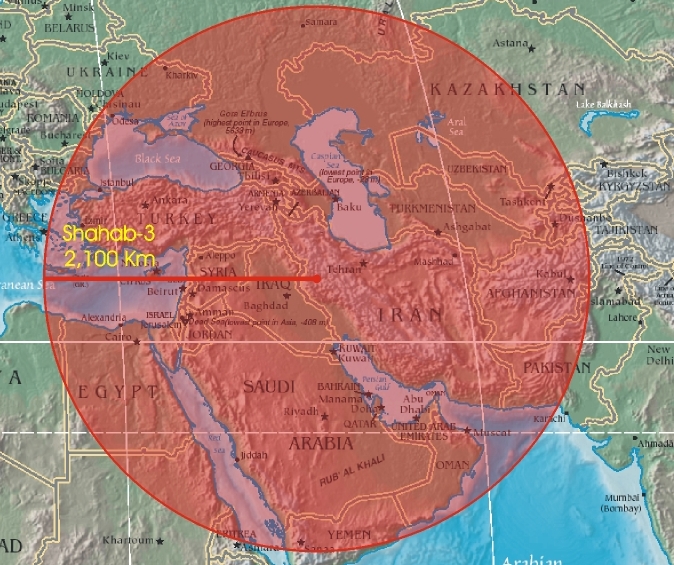
Shahab 3 Range

It is likely that the threat of joint US and Turkish intervention in Syria, led to Iran announcing the Great Prophet 6 military exercise. This exercise took place in the Northern borders close to Turkey and showcased the nuclear capable Shahab 3 missile (capable of striking targets in Europe). 

Iraq/Iran


Iran is developing the Mahdi army and Badr Brigade (part of the supreme Islamic Council) into a professional militia/force, that is an alternate to Hezbollah (or as powerful as Hezbollah).


The IRGC told them the plan is to reorganise the militia and arm them. So intructors will be giving them training in weapons handling and Missile launching. So the aim is to develop a force that can intervene in Syria, Lebanon - in support of Hezbollah and augment hezbollah operations in setting up covert cells in Kuwait, Bahrain, KSA. So if Hezbollah can't, the Mahdi army will take over setting up cells in GCC.

Tensions are rising again as Iran wants to make sure that the US does not retain any presence in Afghanistan and in Iraq. In order to achieve this, Iran has partnered with Pakistan and Iraq. Therefore, Iran has delivered more weapons to be used against the US troops in both Afghanistan and Iraq. Sadr has issued more threats and has even permitted suicide attacks against the US troops.

The US has wanted to change its role from a force that is currently policing the streets into a pure counter terror role and support Iraqi forces or Afghan National Army operations against insurgents. We can expect this to occur over the next few months.

"The current discussions cover both, and there are very clear capability gaps that the Iraqi security forces are going to have," Mullen said, citing air defense, aviation and elements of intelligence.


Iran


We understand that western intelligence agencies have concluded that Iran has now produced its first nuclear bomb prototype that is ready to be tested. Iran took advantage of the chaos during the "Arab Spring" to accelerate its program. Recently announcing that Iran will send a monkey into space. Any military analyst will point out that being able to put a payload into space will demonstrate ICBM capability. Rumours are circulating that a blame game has begun within western intelligence agencies.

It is likely that KSA and Turkey will come out with a plan to test nuclear weapons. Prince Turki has been the most vocal in this. Pakistan meanwhile has been expanding its nuclear weapons stockpile significantly and is likely to transfer the weapons technology. We have already reported in a previous article on GCC - Pakistan relations, of Saudi nuclear scientists receiving training in Pakistan. The GCC nuclear program is likely to be based in Khamis Mushayt and we believe that the program has been running for some years.

------------------
Pyongyang has relaunched North Korea’s enriched uranium production, a move that has coincided with Iran’s stocks growing.

In recent months, several European security services including the DGSE and MI6 have been swapping notes about intelligence from U.S. sources that Tehran has been receiving deliveries of UF6, uranium hexafluoride, used in centrifugation enrichment processes. This news comes at a time when Pyongyang is known to have relaunched its production of nuclear fuel.

The existence of a secret supply source from North Korea, if it turns out to be true, would strengthen the case for tougher sanctions against Iran. A report into secret technological exchange between the two countries, written by the United Nations’ panel of experts that monitors compliance with UN sanctions imposed on Pyongyang, was submitted to the Security Council in May. The report, which has not yet been published on China’s request, covers bilateral cooperation on ballistic missiles. On June 10th, the U.N renewed the panel of experts’ mandate.

----------------------

KSA


KSA and the US have partnered together on anti-AQAP operations. Leon Panetta and Gen. Petraeus have both told lawmakers that GCC will put "maximum" pressure on the AQAP. Prince Turki Al-Faisal and Prince Bandar bin Sultan were said to have lobbied the senior KSA leaders to allow a construction of an airbase for CIA/JSOC to operate drones from KSA. It appears that this base may not be operational yet and it is likely that some missions that began in May are operating from a neighbouring country as well as KSA.

The reason behind KSA okay'ing the plan was to prevent AQAP being given a free hand to operate in Yemen as this could affect the survival of the Kingdom. 

---------------------------------

Thank you for reading! Feel free to email us your comments at "eye.on.middleeast" at gmail dot com

Monday, April 4, 2011

The GCC – Pakistan Relationship


The GCC – Pakistan Relationship

Pakistan and GCC countries enjoy close bilateral relations. Although all GCC nations have fairly close relations with Pakistan, the Kingdom of Saudi Arabia (KSA) stands out as having the closest relations with Pakistan. Successive Saudi leaders have visited Pakistan from time to time. King Saud visited Pakistan in 1954, King Faisal in 1966 and 1974. King Khalid in 1976. Similarly, King Fahd as Crown Prince visited Pakistan in 1980 and King Abdullah went to Pakistan as Crown Prince in 1984, 1997, 1998 and 2003.

What are the Fundamentals of this relationship?
What keeps the bonds strong is the significant economic aid that Pakistan enjoys, dynasties in the Arabian Gulf enjoy protection from the Pakistani military and lastly religious affinity.

Economic Aid

The First and foremost problem with Pakistan is that, it is a country that survives on economic aid to sustain the functioning of the country. If it were not for this aid, Pakistan would be close to economic collapse as was seen in the balance of payments crisis in 2008[1]. The 2 major contributors to this are the United States and the Kingdom of Saudi Arabia. Other GCC countries also contribute to the coffers of the Pakistani government, but none to the tune of KSA. The United States since 9/11 have contributed close to $17 billion in aid to Pakistan according to statistics[2] recently published. In late 2009, the US congress agreed to a package of $7.5 billion in civil aid over 5 years as well as an additional $2billion in military aid agreed in October 2010[3]. There are no public figures to aid offered by KSA however; many have mentioned that contributions are significant – for example when oil prices reached their peak of $147, the Pakistani government had received a $300million grant from KSA in order to provide a budgetary cushion (in order to fill the fiscal gap) to the high oil prices.

In May 1998 when Pakistan was deciding whether to respond to India’s test of five nuclear weapons, the Saudis promised 50,000 barrels per day of free oil to help the Pakistanis cope with the economic sanctions that might be triggered by a counter test. The Saudi oil commitment was a key to then Prime Minster Nawaz Sharif’s decision to proceed with testing. It cushioned the subsequent U.S. and EU sanctions on Pakistan considerably[4]. The post-1998 economic support by KSA was maintained for 3 years with deferred payments which were written off at the end of the term. In early 2008, they again agreed to deferred payments.

As one can see, Pakistan's corrupt and security-phobic mindset squanders away its finances without investing in developmental activities and is hence highly reliant on economic aid from the US and the KSA in particular. Pakistan greatly relies on the support provided by the KSA in order to survive. Pakistan spends more money on military expenditure (estimated to be $5billion, of course Pakistan receives aid in addition to this which mostly is military[5]) than education (estimated to be just 2.2% of GDP – i.e. $3 billion).


Military Relations

One of the major components to the Pakistani – GCC relations is military cooperation. Due to the economic situation of Pakistan, Pakistan has relied on other nations footing the bill for defence requirements. Most of the Pakistani defence requirements are provided under the guise of military aid to combat terror. However, it is acknowledged that much of the military aid is actually being diverted to being used to fund weapons purchases in order to be used against India - Former president Pervez Musharraf admitted that US military aid given to Pakistan during his tenure was used to strengthen defences against India[6].

What about cooperation between Pakistan and the GCC?

Pakistan has provided military aid and expertise to the kingdom for decades. It began with help to the Royal Saudi Air Force to build and pilot its first jet fighters in the 1960s. Pakistani Air Force pilots flew RSAF Lightning’s that repulsed a South Yemeni incursion into the kingdom’s southern border in 1969. In the 1970s and 1980s up to 15,000 Pakistani troops were stationed in the kingdom[7].

As recently as late 2009/early 2010, during the Saudi conflict with the Houthi rebels, Pakistani forces had been deployed. This author understands that Pakistani Air Force pilots were operating missions in support of Saudi forces fighting the Houthi rebels. Some unverified sources have suggested that the Pakistani Air Force were paid per mission undertaken in the conflict.

During the visit of Assistant Defence Minister of KSA Prince Khaled bin Sultan to Pakistan in 2004, a tighter military cooperation was made between the 2 countries[8]. For the first time a discreet visit to Kahuta was also made. Kahuta is home to Khan Research Laboratories which houses Pakistani nuclear arms facilities.

Here are some highlights of the defence relations between the 2 countries:
-         Increase in training of the number of Saudi nuclear physicists at KRL, Kahuta[9]
-         Support Pakistani defence industry by purchasing Al Khalid tanks and offering sub-contractor work for the $7billion Saudi MIKSA border protection program to Pakistani government contractors.
-         Stationing of a 1000 pakistani soldiers in KSA, with the option to increase to 80,000 in the event of a major conflict.
-         A joint military Command in Saudi Arabia with pre-positioned arms dumps.
-         Possible integration with the Peninsula Shield in Hafr Al Bateen along with allied states such as Egypt.
-         Saudi pilots will travel to Rawalpindi for training along with Pakistani Air Force pilots.
-         There are persistant rumours that Pakistan acted as a conduit for nuclear capable missiles to Saudi Arabia.

Any close watchers of the region can see that Pakistan co-ordinates military purchases closely with the GCC. It is also a well known fact that Pakistani defence purchases are partly paid for by the KSA. Purchase of French Agosta submarines as well as US F-16D’s were some of the examples. This is done so that the GCC can call upon the services of the Pakistani armed forces when needed.

The author understands that Riyadh relies on Pakistani personnel to fill in gaps in personnel in the Saudi military – mainly the Air Force which flies similar aircraft to the Pakistani Air Force. The agreement is that in exchange for bankrolling Pakistani purchases of defence equipment, in return Pakistan provides some of its more experienced pilots/naval officers to be seconded to the Saudi military.

The Downsides to relations with Pakistan

It is apparent today that most major terror plots involve Pakistan in some way or form – usually training and other support. Muscat was made the target of attacks in 2007. Lashkar sympathisers in Oman had plans of targeting prominent landmarks in Muscat, among them a British Broadcasting Corporation office, the Golden Tulip Hotel, and a spa in the upmarket Nizwa area. No final operational plans were made, but Oman authorities found enough evidence to sentence suspects to life in prison.

For further info on the planned attacks in Oman and how Omani and Indian investigators worked together on the Mumbai Attacks please read:
http://www.hindu.com/2009/05/28/stories/2009052860421000.htm
http://www.hindu.com/2009/05/28/stories/2009052850390100.htm

Members of the AQAP (Al Qaeda in the Arabian Peninsula) are also known to be very active in the Af-Pak region and evidence suggests that these individuals receive support from the Pakistani ISI (Inter Services Intelligence). It is also noteworthy to remember that the head of the Al Qaeda’s military wing Brigade 313 is Ilyas Kashmiri – A former member of the Pakistani Army’s Special Services Group (SSG). A well known fact is that the Pakistani army is known to use the services of ex-servicemen for supporting jihadi/terror activities targeting India and ISAF troops (of which Bahrain and the UAE militaries also have a presence) in Afghanistan[10].

It is also not a coincidence that the Saudi ministry of interior recently released names of 47 most wanted terrorists, of which the majority (27) were located in the Af-Pak region. Majority of these leaders are likely to be living under protection of Taliban and their allies such as the Haqqani network. Many of these groups are armed and trained by the Pakistani military. It is also well acknowledged that the Taliban and its leadership are under the control of the ISI[11]. A question GCC security officials need to ask themselves is, is it worth supporting a nation that continues to harbor/support individuals that are trying to topple their governments?

The GCC officials should also be reminded that one of the gravest threats they face today – the Iranian nuclear threat - was caused directly by Pakistan. Evidence has emerged that the “father of the Pakistani bomb” Abdul Qadeer Khan had sold equipment/know how in his nuclear black market to Iran[12]. There are also indications that AQ Khan was aided and abetted by Senior Pakistani military and intelligence officials. In fact AQ Khan himself claimed that Musharraf was aware of the nuclear black market trade and approved deals[13].

It’s no secret that GCC officials are worried about the threat emanating from Iran as we have all read in the wikileaks episode. Again, the question needs to be asked, Is this the partner that GCC wishes to rely upon for its security?

Why is this relevant today?

Many analysts have completely missed the significance of recent high level visits from Kingdom of Saudi Arabia and Bahrain to Pakistan. Prince Bandar (A royal emissary for HM King Abdullah of Saudi Arabia) had visited senior leaders in Pakistan including the Pakistani Army Chief General Ashfaq Kiyani. Sources have confirmed that Prince Bandar is said to have requested Pakistani troops to be deployed if the internal unrest continues in Yemen, Bahrain and the Eastern Province of Saudi Arabia.
The Foreign Minister of Bahrain HRH Shaikh Khalid bin Ahmed bin Mohammed Al Khalifa also paid a visit to Islamabad shortly after Prince Bandar had departed for New Delhi [14]. We expect similar discussions on security coordination to have taken place.

Conclusion

Pakistan army is being utilized as cannon fodder or mercenaries for the Gulf Kingdoms, in return Pakistan gains significant economic support that it requires for its very survival. How long will this relationship continue and also how reliable is this support if Pakistan continues to harbour or indirectly/directly support the AQAP as well as a Nuclear Iran? Is it time for the GCC to start imposing conditions on Pakistan for its continued aid?  

I leave you with a quote from the book (My Life with the Taliban) of Mullah Abdul Salam Zaeef, Taliban regimes Ambassador to Pakistan:

Pakistan, which plays a key role in Asia, is so famous for treachery that it is said they can get milk from a bull. They have two tongues in one mouth, and two faces on one head so they can speak everybody’s language; they use everybody, deceive everybody. They deceive the Arabs under the guise of Islamic nuclear power, they milk America and Europe in the alliance against terrorism, and they have been deceiving Pakistani and other Muslims around the world in the name of the Kashmiri jihad.”


[1] http://www.huffingtonpost.com/2008/11/15/pakistan-agrees-to-76-bil_n_144080.html Pakistan said Saturday it had agreed to borrow $7.6 billion from the International Monetary Fund
[8] Data Source
[9] Data Source
[10] http://www.timesonline.co.uk/tol/news/world/asia/article4926401.ece Taliban leader killed by SAS was a Pakistani Army officer

Thursday, March 24, 2011

Quick Update: Libya, Syria + GCC


Hi Folks!

Here is a short update on Libya as well as the GCC.


British Royal Air Force (RAF) Typhoon aircraft taxi at Gioia Dell Colle Air Base, in Italy March 22, 2011

Libya

  • We expect to see more coalition strikes on Gaddafi's armed forces. In particular we expect Libyan tanks and other artillery equipment to be destroyed over the next few days.
  • If a settlement is to be agreed, we expect the country to be split into 2 - Tripolitania and Cyrenica. Where Gaddafi will retain control of the West (Tripolitania) with the rebels holding the East (Cyrenica).
  • The person running the rebellion is Gaddafi's former interior minister Younis Al Obaidi, who is backed by a few military officers.
  • One of the officers backing Obaidi is supposedly close to the US pentagon. As the WSJ had reported the Libyan National Council can rely on arms supplies coming from over the border in Egypt that is indeed partly financed by the KSA.
  • Obaidi's aim is to recapture Adjdabia from the Gaddafi forces, since the western coalition air force is taking out any Gaddafi forces on the main highways. Once this is complete, we believe he will head for the coastal oil transportation hubs - especially Ras Lanouf ( a site of a major oil export terminal). 
  • Capture of these oil export terminals would mean oil revenues and hence greater viability of the state of Cyrenica. Establishing a state of Cyrenaica is the minimum the rebels aim to achieve at the moment.
  • A problem Obaidi is facing is that the force is filled with enthusiastic civilians who have very little military training. 
  • Meanwhile Gaddafi is aiming to grab Zintan and Misrata as well as other Western towns. These cities would be important to be able to stabilise the Tripolitania region.
  • We expect additional political appointments to be made over the coming week - we strongly expect Ali Issawi (the former Ambassador to India) to be given a very senior posting - either in Foreign Affairs or Economy.
  • We believe most western capitals are now debating on the end game in Libya - as in what the west hopes to achieve in Libya. Also at what point do they cease military operations.

GCC

Soldiers from the Gulf Cooperation Council (GCC) forces guard the entrance to the Pearl Square from their armoured vehicles in Manama, March 19, 2011.


KUWAIT CITY — Arab states in the Gulf plan to deport thousands of Lebanese Shiites over their alleged links to Hezbollah and Iran's elite Revolutionary Guard force, a Kuwaiti newspaper reported on Thursday.
Al-Seyassah, quoting London-based Arab diplomatic sources, said the measure was being considered because of intelligence reports that Lebanese Shiites activists had been involved in protests in Bahrain and Saudi Arabia.
Based on the assessments by the United States, France and Bahrain, alleged Hezbollah and Revolutionary Guard agents were leading the protests along with local Shiite clerics in Bahrain and Saudi Arabia's Eastern Province, it said.
It said Bahrain's decision to suspend flights to Iran, Iraq and Lebanon and its condemnation of remarks by Hezbollah chief Hassan Nasrallah had "paved the way for the deportation of thousands of Lebanese Shiites from the Gulf."
"No Lebanese Shiite linked to or suspected of being associated with Hezbollah and the Revolutionary Guards will remain in the Gulf," the diplomatic sources said, citing high-ranking Bahraini officials.
Bahrain is preparing to deport 90 Lebanese Shiites, most of them arrested during the Shiite-led, pro-democracy in the kingdom, and is examining the status of 4,000 Lebanese families living in the Gulf kingdom, the sources said.
Last week, Bahraini authorities carried out a bloody crackdown on the protesters who have been demanding political reforms since February 14 in the tiny Shiite-majority, Sunni-ruled kingdom.
The crackdown came hours after a Saudi-led joint Gulf force rolled into Bahrain to back up the regime, a move condemned by Shiite Iran and the head of Lebanon's Shiite militant Hezbollah who has offered to help the demonstrators.
On top of the suspension of flights to Beirut by its two national carriers, Manama has advised Bahraini citizens to avoid travel to Lebanon, a popular destination for wealthy Gulf Arabs.
"Due to threats and interference by terrorists," the Bahraini foreign ministry said on Tuesday it "warns and advises its citizens not to travel to the Republic of Lebanon as they might face dangers threatening their safety."

Bahrain and KSA have pointed the finger at Iran for the unrests that have taken place over the last few weeks. This is evident by HM King Hamad's speeches of an external hand in the protests and also by the expulsion of diplomats between Iran and Bahrian.

The expulsion of Lebanese nationals appears solely directed at Iran and Iranian interests. The MOIS (Iranian Ministry of Intelligence Servies) and IRGC (Iranian Revolutionary Guards Corps) are known to use Lebanese nationals for their operations in the GCC. This article suggests that several individuals appear to have been caught taking part in protests.

The expulsions of Lebanese individuals linked to the Hezbollah will serve to heighten the tensions between Iran and also to protect the KSA and Bahrain from any potential Iranian involvement in any unrest or future protests.

 Due to the large Lebanese community in Bahrain, any expulsion may also serve as a sanctioning of the Hezbollah led Lebanese government. We see this similar to the sanctioning of the Hamas government in Gaza by the EU after winning the democratic led elections. However for this to be truly effective, it would require a GCC wide expulsion of Lebanese individuals - the article above does suggest that there may be a GCC wide expulsion and we agree that a GCC wide expulsion may take place. There have been reports in late 2010 of expulsion of Hezbollah supporters from the UAE, so this would not be the first time that a Gulf state has taken action against lebanese expatriates in the Gulf.

Iran has making its own moves recently, by allowing Iraqi shi'ite political parties to form an alliance against the "KSA intervention" in Bahrain. This alliance has threatened to open a front (by sending shia tribes to the border) in the KSA/Iraq border in solidarity with the Bahraini shia.

Syria

In light of the major protests in Syria. This has caused serious worries of instability in neighbouring Iraq - across all parts of the country. Therefore, the Kurdistan Regional Government and the central government in Baghdad have struck an agreement to provide for security of all northern iraqi oil fields.

It appears that there is a heightened risk of serious instability all over Iraq as a result of a protests in Syria. We expect tightening of the border security between Syria and Iraq over the next few days in order to prevent any instability spreading into Iraq.

----------------------

Thank you for reading. Feel free to email us any questions you have to eye.on.middleeast "at" gmail "dot" com.

Wednesday, March 2, 2011

MENA Region - Quick Update

Editor has not been sleeping and is watching the current events unfold.

First Stop: Libya

Many are wondering what is going on in Libya. We'll make this simple.
The eastern side of Libya is currently held by "rebels". These rebels are essentially members of the armed forces of Libya and the people.


Do we see them winning? Nope. We do not. As long as Gaddafi continues to control the Airspace,
he may continue to bring in troops/Mercenaries from Niger, Chad, Syria etc. Yes that's right Syria is not a typo, Syria is showing solidarity with Libya and in the event of a full scale war, Syria will send their pilots to fly on behalf of the Libyan Air Force.

We believe that the western intelligence agencies are busy on the ground in Libya, trying to organise the rebel movement and of course evacuate their nationals. So far the french and british have delivered "aid" and weapons to the rebels.

Rebel soldiers teach civilians who have volunteered to join the rebel army at a school in Benghazi March 2, 2011. The rebel army is preparing to fight Libyan leader Muammar Gaddafi's forces if necessary, an official in the rebel army said.


Talks of no-fly zone are just that - talk, at the moment. Its something that is too difficult to impose as it would involve a US/western intervention and bombing spree. The current economic/political climate in the EU and the US does not allow for this - which is evidenced by Secretary of Defence Gates comments in the last few days.

No one appears to be covering the damage that the current crisis is going to cause the Spanish economy, which would feed into the EU economies. 

So in summary: We do not see an intervention by the West at this juncture. Rebels are slowly losing territory to Gaddafi's military evidenced by re-gaining Al Bayda today. Unless, the west enforces a no fly zone via Egypt etc anti-government forces will get over run.

We'd also like to point out that there is a heavy propaganda going on here by the west. Good quality information is particularly hard to receive at the moment.

Shades of Saddam here. By no means is this over yet - this war may continue for a while.


Next Stop: Bahrain

The process of national dialogue has begun by Crown Prince Sheikh Salman, the PM and Sheikh Nasser bin Hamad (HM King Hamad's son playing a limited role).

The opposition party Wefaq and Haq have met and are discussing their position on the issue. To date it appears they have agreed on certain issues and have had some disagreements. It is not clear what each's position is on asking for a constitutional monarchy.

The author commends the Crown Prince's call for dialogue. It is clear that others have copied this process/idea -> President Saleh (Yemen), Saif Al Gaddafi (Libya) are doing similar things.

The talk of the town was Bahraini King Sheikh Hamad visiting Riyadh to receive King Abdullah of KSA in Riyadh last week.


Saudi Arabia's Crown Prince Sultan (R) smiles with Bahrain's King Hamad bin Isa as they welcome the arrival of Saudi Arabia's King Abdullah, in Riyadh February 23, 2011.
King Abdullah got straight to business after landing. He had to deal with the Bahrain issue and also internal family issues that needed sorting out.

Regarding Bahrain, King Abdullah affirmed support to Bahrain and to the royal family. He told King Hamad that he supports the dialogue process initiated by the Crown Prince. They both agreed that using violence by the police or military is not the answer as it will eventually help Iran. King Abdullah also said that there are 3,000 Saudi troops stationed in the east that are on alert and are ready to help support the BDF (Bahrain Defence Force). Saudi officers are present already in Bahrain to help with any coordination, in the event of a crisis.

Oman

Protests have taken place in an industrial city of Sohar and troops have been deployed. We are monitoring this situation closely.

This is not an anti-monarchy protest. The people are in support of Sultan Qaboos, however they are not happy with the government ministers, whom they accuse of corruption. It is also about jobs for the unemployed and so on. We expect the protestors demands to be met to a certain extent and this will probably go away in a matter of days.

India and GCC

Prince Turki Al Faisal will be in New Delhi on the eve of the first Joint Indo-Saudi military exercises in India.

Omani troops are also expected to come to India for a massive Air, Sea and Land exercise in India this month.

Army Chief to visit US Centcom HQ


The India-US military relationship is set for a qualitative leap with the first ever visit of an Indian Army Chief to the headquarters of the US Central Command (Centcom), which has charge of Af-Pak, the Middle East and Iraq.

Gen. V K Singh will visit the Tampa, Florida-based Command in his 10-day trip to the US between March 6 and 15 with an aim to set up a Brigadier-level direct liaison with the Indian Army. India liaises only with the US Pacific Command, and having a liaison officer in Tampa will signal a recognition of Indian interests in the arc from the Gulf of Aden to the Straits of Malacca, government sources said.

The Centcom liaison and acquisition of M777 ultralight howitzers will figure in the bilateral Defence Policy Group meeting, for which a high-level delegation led by Defence Secretary Pradeep Kumar is going to Washington on March 1. Sources said Gen. Singh will meet Centcom Commander Gen. James Mattis on March 8 to discuss the situation in Af-Pak, the Arab world and Iraq. Gen. Singh will also hold talks with his US counterpart Gen. George W Casey Jr.

IndianExpress


Watch this space!
----

Thanks for reading. Feel free to email us any questions at eye.on.middleeast "at" gmail "dot" com

Monday, January 3, 2011

Iran and the Nuclear Issue

Iran has been dominating the news over the last few years, mainly due to its development of a Nuclear Program.
Lets assess the issue at large, interests of each country in the region and world at large.


Iran's Nuclear Program 

Iran's nuclear program appears to be the most pressing issue for the GCC and the west.

What does Iran stand to gain by going nuclear?

It is the same reason why India and others went nuclear. In the words of Former Indian President Abdul Kalam, nuclear weapons are a "weapon of peace". First and foremost for Iran, it is to deter aggressors/bullying and protect the country from the US. Having a nuclear weapon, can deter a major war and essentially cements Irans position as a regional and international player in politics.
Secondly, I believe it allows Iran to flex its muscles regionally. Consequently this is the biggest worry for those in the GCC.

The Iranians continue to agree to talk, just in order to stall for time and keep the clock ticking so that Iranian nuclear scientists can continue to work. It’s just a question of time for the Iranians to come out and say they have a bomb ready for testing.

Will the Iranians actually use it?

You may have heard in the press of Ahmadinejad telling people that Israel will be wiped off the map etc. The west is using this as a tool to scare ordinary people and obtain support for their governments actions on stopping the Iranian nuclear program.

No nation is crazy enough to use it as it will likely be met with an equi-proportionate nuclear response, especially if the target nation has a triad of nuclear missiles (Missiles/Bombs deliverable via Land systems, Airplanes and using Submarines).

Iran and perhaps the nuclear powers too, believe in MAD (Mutually Assured Destruction). This is where both sides have enough nuclear missiles to cause serious damage to each other.

So its safe to say that Iran isn't actually getting a nuclear weapon in order to use it, its more of a deterrent and use as a support to foreign policy objectives. However, as the USSR showed us, possessing a nuclear weapon does not guarantee the regime power to rule for an infinite period. Regime change is still very much possible and will continue to be a major threat in my opinion.

Factors to keep in mind:
- It takes more than one test to perfect the weapon (The West have conducted 100's of tests to perfect theirs)
- Even once you have a weapon, you need a credible delivery vehicle that can reach your intended enemy. This can take many years.

Anyone interested in understanding why India went nuclear and how it outsmarted the US in going nuclear, please read Weapons of Peace: The Secret Story of India's quest to become a Nuclear Power by Raj Chengappa.

The US

The views of the senior leadership in Iran is that the US cannot afford another major war. The US has announced timelines to pull out of Iraq and any increase in violence in Iraq will probably slow this process. Iran can obviously make it difficult for the US to pull out. An attack on Iran will in all likeliness cause an upsurge in violence in Iraq by Al Qods forces (Iranian special forces troops controlled by the Iranian Revolutionary Guard Corps). and Iranian controlled militia - specifically the Mahdi army (Officially disbanded but highly active in the South of Iraq) who have been undergoing training with the Hezbollah/IRGC in Iran.


Of course this is also a similar situation in Afghanistan, where certain part of the Taliban are backed by Iran. Evidence of Iranian made shells, weapons etc have showed up in Afghanistan[1]. Members of the Taliban still receive training in Iranian bases close to the border with Afghanistan.

Now the biggest reason why the US can't afford another war is because of its economy. Recent data published by the US Department of Labor of high unemployment (9.8%[2]) Some people go as far as to say that the unofficial US unemployment rate taking into consideration those that have not claimed unemployment benefits is around 1 in 5 people. The economic situation is not improving very much either, this can be witnessed by recent remarks of Ben Bernanke and further stimulus plans.

Imagine if the US was to go to war with Iran, would ordinary people in the street in the West be happy with this? Probably not. Public opinion would frown at such an idea, and will not be happy with a significant portion of their budgets/taxes being spent on "another war!”. Tehran also appears to agree with the idea that US cannot afford another war[3]. In my opinion this is also the same reason why Israel is being held back from attacking Iran, simply because Israel would not be doing itself any favours with the West (support that it needs for its very survival).

The GCC


The GCC is the one that is most worried about the Iranian threat. One can witness the statements from the recent wikileaks saga:  HM King Abdullah of Saudi Arabia repeatedly exhorted the United States to "cut off the head of the snake" by launching military strikes to destroy Iran's nuclear program.

HM King Hamad of Bahrain argued "forcefully for taking action to terminate  Iran's nuclear program, by whatever means necessary". "That program must be stopped," he was quoted as saying. "The danger of letting it go on is greater than the danger of stopping".

An Iranian nuclear weapon will provide a lot of power on foreign policy. Each nation in the GCC approaches the issue of Iran differently:

KSA

A crux of the issue for the Saudi's appears to be that Iran is a challenge for their regional power and a leader of Islam.

There are also worries that Iran will be able to meddle in the internal affairs of the Kingdom, especially amongst the significant Shia population in the East of the Kingdom (the majority of saudi oil is located in this region). Worst comes to worst Iran could back a succession movement in the East of the Kingdom.

Bahrain

 Similar to the Saudi's, there is a significant Shi'ite population in the island nation. Bahrain has a long history with Iranian meddling in Internal affairs of Bahrain. The majority of the population in Bahrain is Shi'ite and the rulers are Sunni. I'll go into Iranian activities in the GCC as a whole in another post.

Qatar

Main issue for Qatar is believe it or not NATURAL GAS! Both Iran and Qatar share the worlds largest natural gas fields. They are competitors, in this way and are trying to extract as much gas as possible. As the sea borders are not actually demarcated by either Iran or Qatar, this can be a source of conflict. Iran has displayed aggression here by routinely sending IRGC personnel in boats to damage Qatari Gas infrastructure[4].

UAE


Lesser Tunb, Greater Tunb and Abu Mussa Islands that are claimed by the UAE but currently under occupation of Iran.

The GCC

I have left out Kuwait, Oman and Qatar on purpose as most of the issues are covered above. Iran has made threats of attacking GCC nations in the event of any US/Israeli strike coming from their territory. Iranians have also made it clear that they have covert cells in the GCC, in the event of war, will be activated to damage infrastructure (electricity, roads, etc), conduct suicide attacks.

Is this threat for real? Bahrain has faced these threats from the 80s and have dismantled many cells since. Even to this day, building construction work in Manama usually ends up finding buried cache's of professionally packed weapons[5].

Trained in Iran or in Hezbollah camps in the Oronte valley in Lebanon, the elements aim to launch sabotage operations against American and European interests in the event of an attack against Iran. In the event of a war, Iran will use these sleeper cells to launch a civil disobedience movement and send people to the US embassy and to the HQ of the 5th fleet in Manama5.

The Saudi decision to set up a force to protect oil facilities came because of the discovery of Iranian infiltrated operatives in the East of the Kingdom.

So in short, Yes the Iranian threat is very real.

Conclusion

Will there be war?

Mmm.... Not sure. At this point in time, the US can't afford a war and neither will the US let anyone else launch any attacks against Iran. But Israel and the West will probably continue to use other methods to slow Iran down - Stuxnet and other covert means.

Does Iran want war?

Despite all the loud noises from Iranian generals of how they will strike their enemies, the Iranians do not want war. Iranians know that they will come out worse in any major war with the US. Iranians are happy to make gutsy moves, like the recent visit to the Lebanon - Israel border by Ahmadinejad, use IRGC boats to intimidate US Navy ships in the Straits of Hormuz. But in my opinion Iran will not do anything major to provoke the US.
In short, neither US or Iran wants a war! Neither will provoke the other in any big way.

What will happen if Iran does nuclearise?

The GCC will make peace with Iran and satisfy their needs. Game theory tells us that the GCC will probably nuclearise (How? Thats a different matter altogether). We have also seen this in the past between India and Pakistan. India was first to nuclearise and Pakistan responded with attaining nuclear weapons[6].
The cheapest option is probably to strike an agreement with one of the nuclear powers - Probably India, Pakistan and the US as the most reliable partners out of the nuclear nations to provide an umbrella. However, will these nations risk getting involved in nuclear war? You decide.
There are a lot of side issues related here that I could not talk about due to time constraints. I hope this has provided readers with a useful basic understanding on what is happening, what the world leaders are thinking about Iran and what we can expect to see in the future.

Thank you for reading.


[2] http://www.bbc.co.uk/news/business-11913196 The US unemployment rate rose to 9.8% in November, the highest rate since April
[3] http://in.reuters.com/article/idINIndia-30081720071020 US in no position for war says Iran minister.
[4] Gulf States Newsletter 845
[5] Gulf States Newsletter 888
[6] http://www.defencejournal.com/2000/june/chagai.htm When Mountains Move, the story of Chagai.